From Clicks to Citations: Building a Brand That Algorithms Can't Ignore

A buyer learned about your business this week from something you didn’t write.
I gave a talk on that idea at Edge of Search in Newcastle in September 2025. It’s about a shift I think most brands haven’t caught up to yet: from a search world built on clicks to one built on citations, and what that means for how you get found, understood, and trusted by both people and algorithms.
Search Is Evolving
We used to live in the Google age. Google crawled the web, indexed it, and handed you 10 or more blue links. You did the work of deciding what to trust.
Fast forward to today and we’re in the AI age. AI reads, generates, and delivers one answer. No choices. Just: “Here’s the truth, trust me.”
That’s not a small shift. It changes what “being found” even means. Being mentioned is becoming more valuable than being visited.
Here’s why I’m convinced of that.
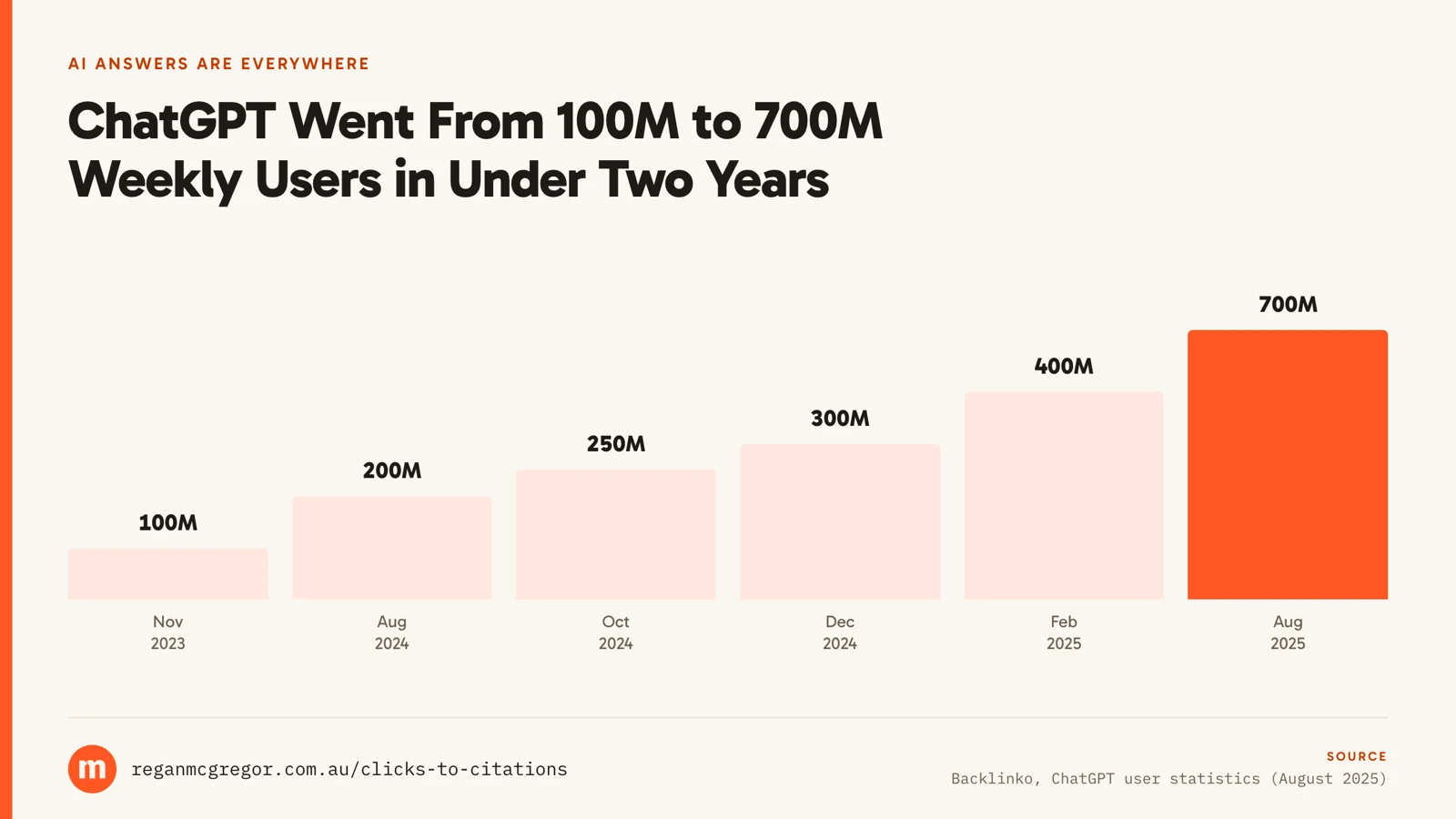
Three years, from novelty to daily habit
Just under 60% of Google searches now end without a single click, 58.5% in the US and 59.7% in the EU, and almost half of mobile searches end the browsing session entirely: roughly double the desktop rate. People are asking questions and getting answers without ever landing on a website.
AI answers are everywhere. ChatGPT has exploded to around 700 million weekly active users. Perplexity handled 780 million queries in May 2025, and was growing more than 20% month-on-month. Google AI Overviews are now showing in 13% of searches.
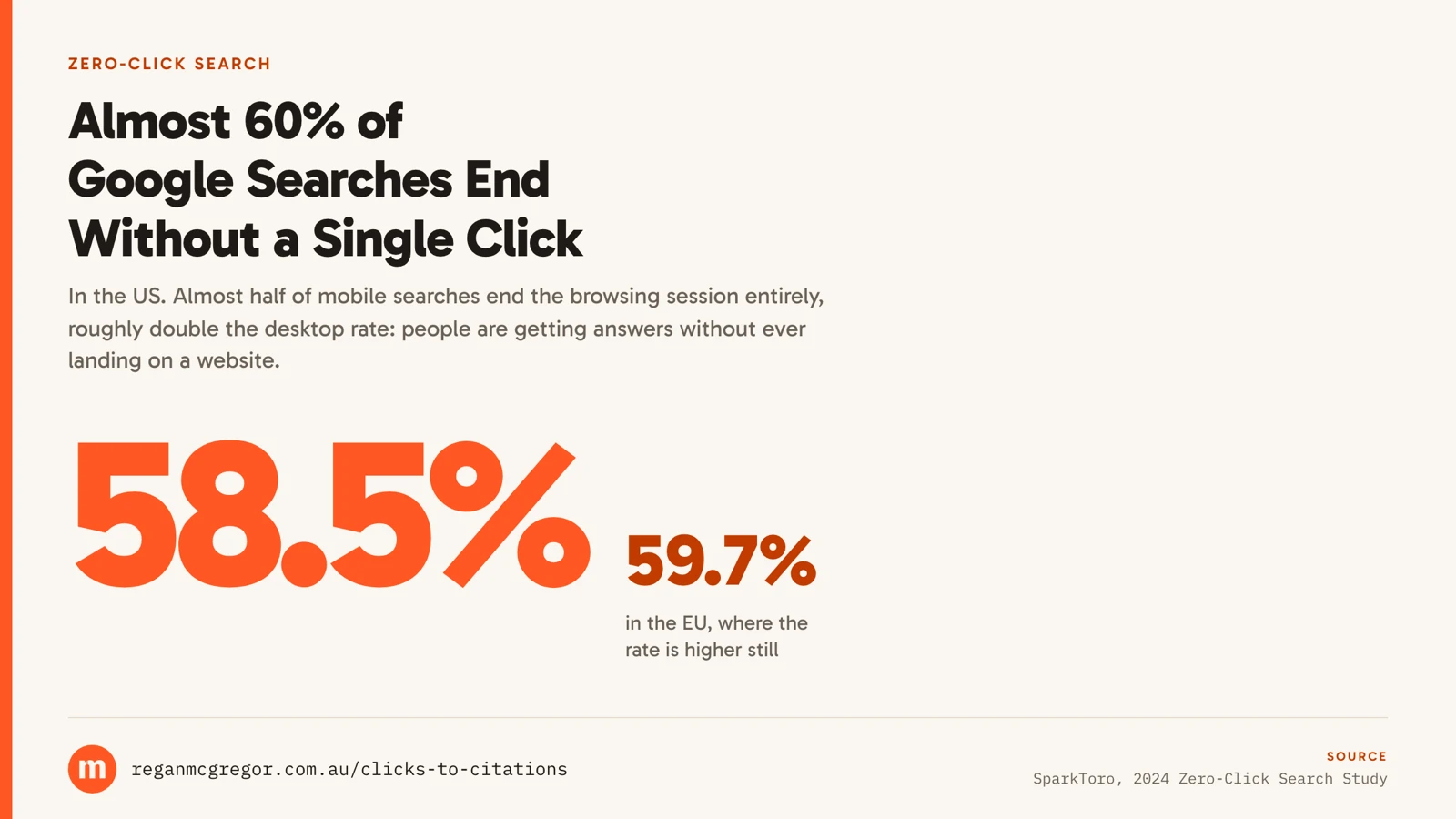
The number that reframes everything else in this post
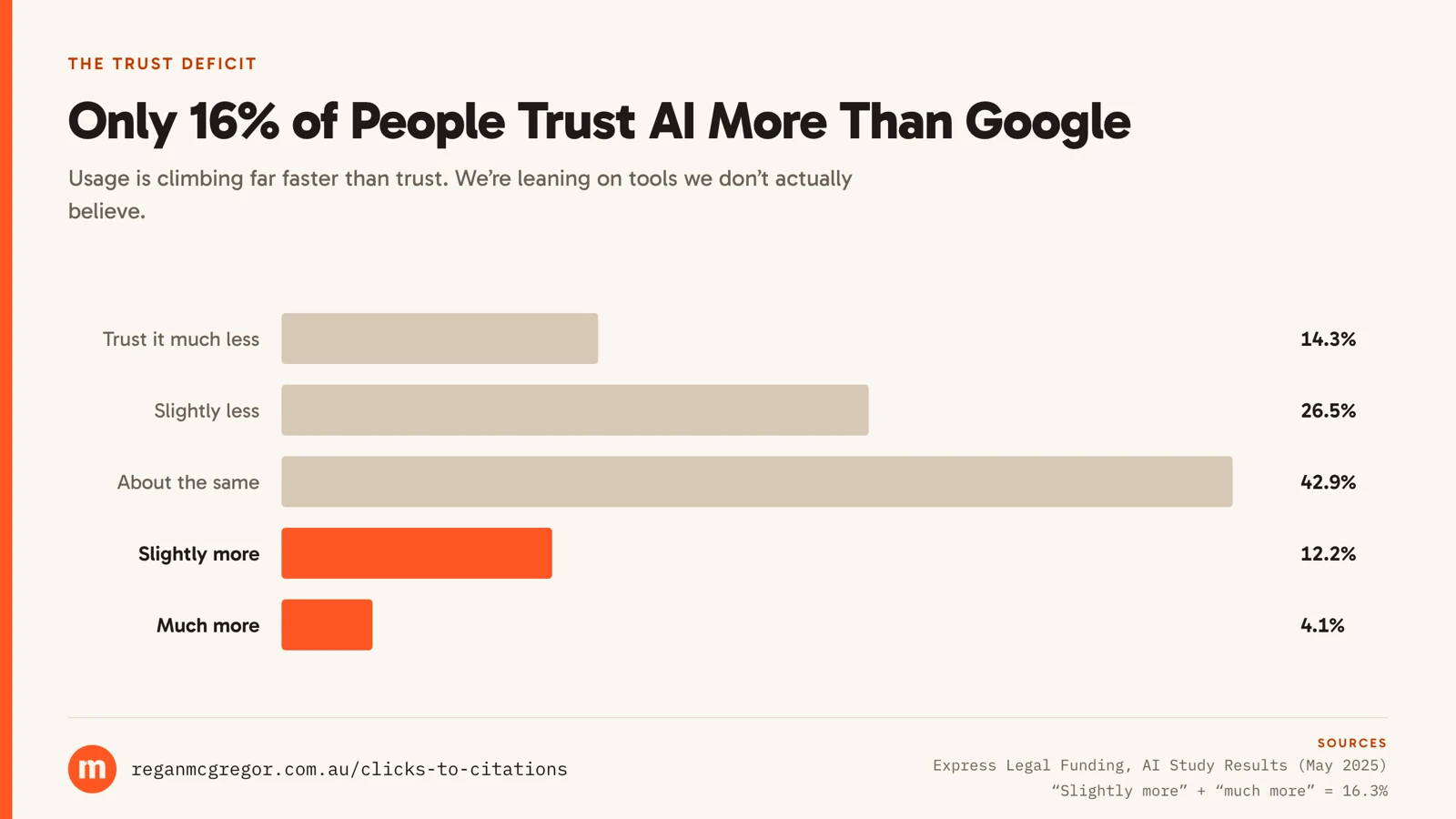
Usage is climbing a lot faster than trust is
But even though AI is everywhere, trust is nowhere. Only 16% of people say they trust AI tools more than Google for getting information. We’re using tools we fundamentally don’t trust.
Why the trust deficit? Partly because the web underneath these answers is getting messier. AI content has surged 8,362% since ChatGPT launched, and by mid-2025 close to 20% of top-20 search results contained AI-generated content, up from around 8% at the end of 2023. Google’s response has been to start pulling the worst of it out of the index entirely: 837 sites were pulled out of the index entirely in the first week of the March 2024 core update, out of roughly 49,000 tracked.
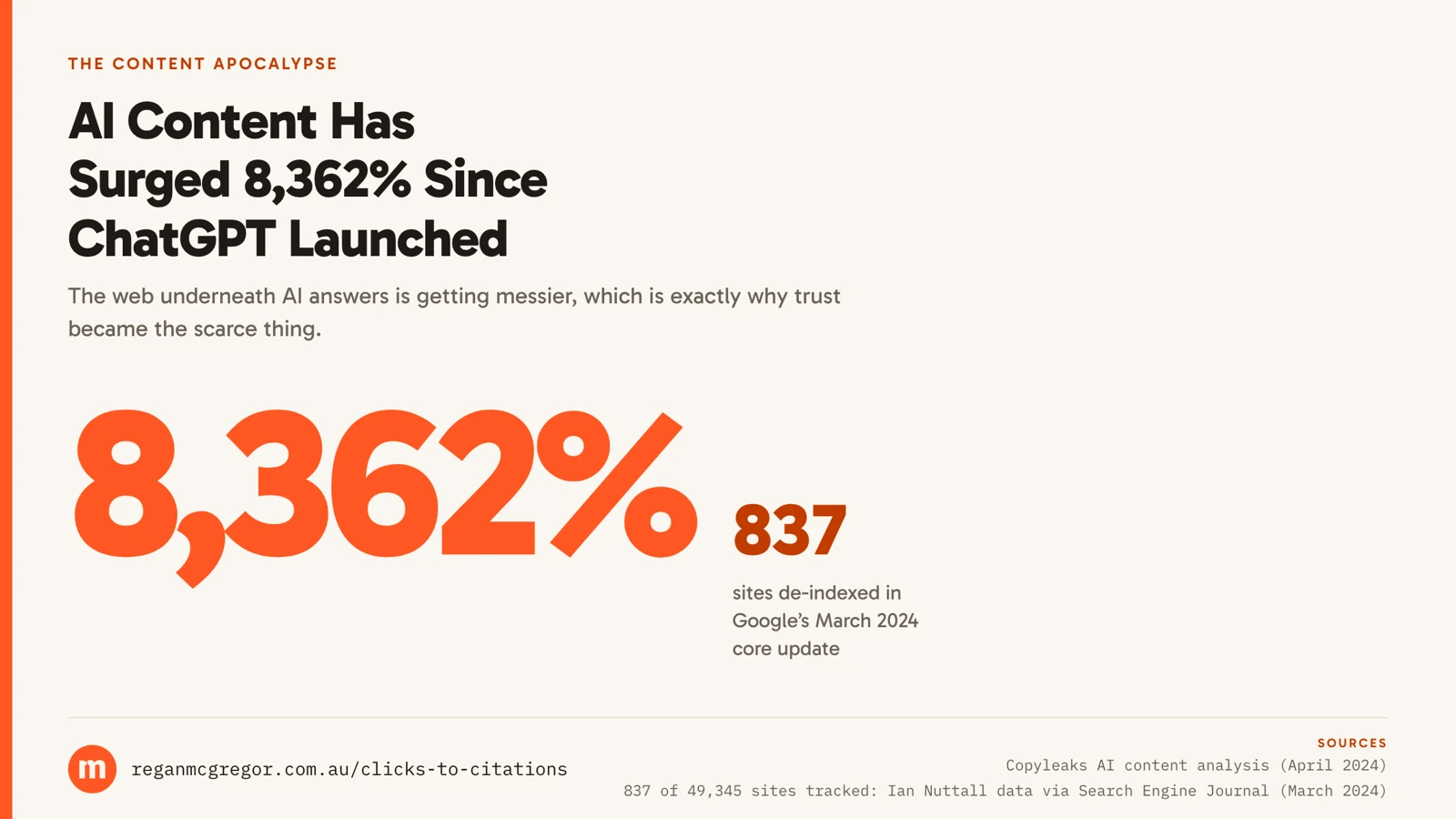
The supply side of the trust problem
And here’s the part that should worry every brand: none of this is making search easier for the people using it. 54% of people say they look through more search results than they did five years ago. 51% say they’re spending more time searching for services online. Most of us now need three or more sources before we’ll actually trust an answer.
Users are working harder for worse answers. That’s the peak of the frustration curve we’re all sitting on right now.
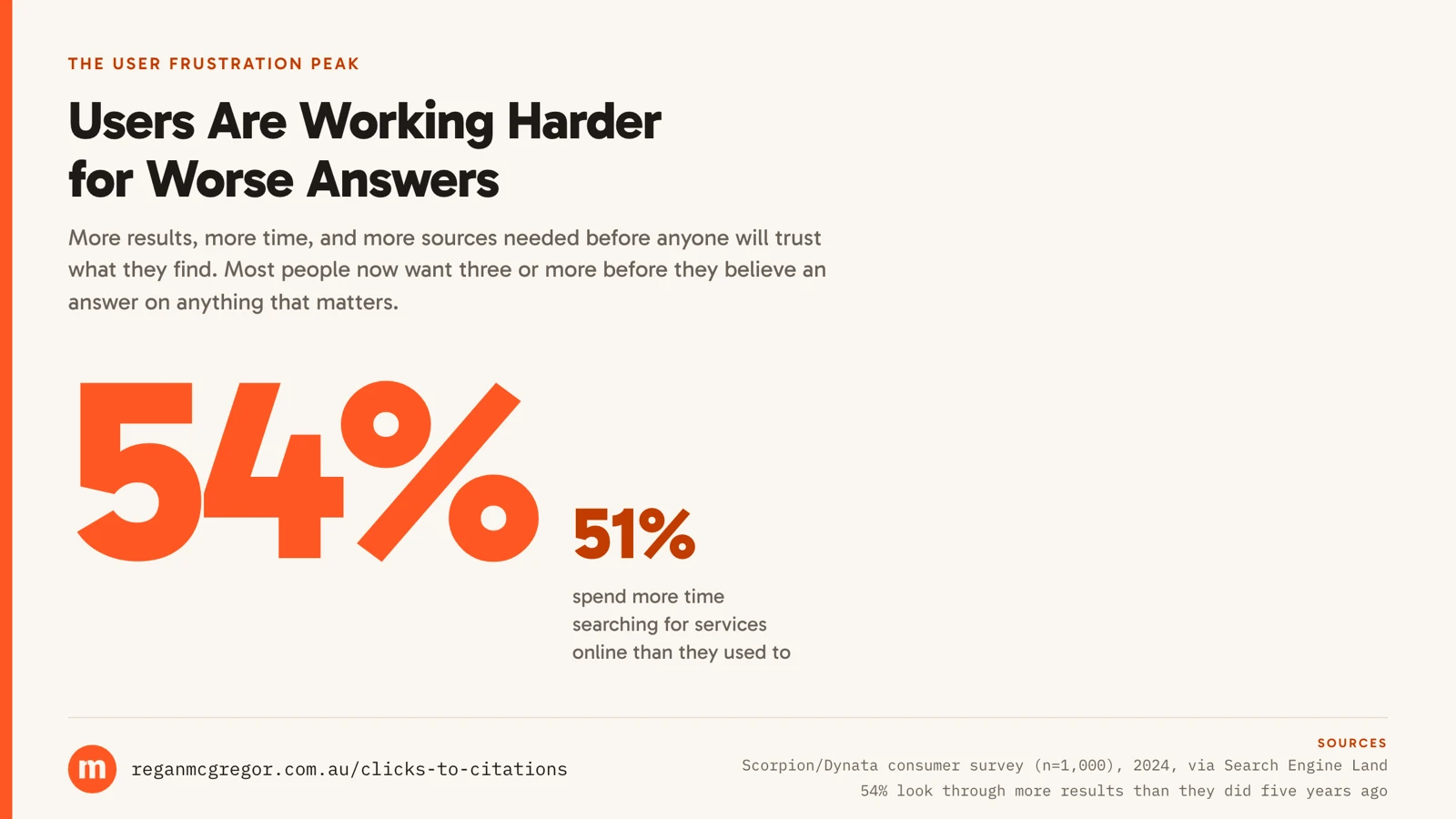
The demand side, people working harder to trust anything they find
So what do we call this new discipline? GEO? AEO? Every few months another acronym turns up promising to be the next SEO. Fine. SEO is dead, long live __O.
Except that’s not really the point, and I don’t think chasing the next three-letter label gets anyone anywhere. This isn’t about acronyms. It’s about the actions users actually take.
Here’s the tell: ask an AI tool a question and watch what it does next. It goes and searches the web for answers. The web hasn’t disappeared; it’s just being read differently, by a different kind of reader.
Users desperately want reliable information. Algorithms need clear signals of authority. And when everything else fails, they both turn to brands they already trust.
Long-term visibility equals trust, not tricks.
So how do you build that trust: how do you become a brand that both users and algorithms choose? It comes down to three pillars: Content, Context, and Confidence. The solution isn’t about fighting algorithms. It’s about becoming undeniably trustworthy. Get this right and your brand becomes not just present, but preferred.
These three pillars aren’t a checklist you tick off once. As I’ll get to at the end, they’re a flywheel: each one feeding the next. But let’s start at the beginning, with content.
Pillar 1. Content: Be Found Everywhere
Without content, you can’t be found online. Content is still king. Whether it’s Google, ChatGPT, or Perplexity, without content there’s no way for these algorithms to understand your brand.
So let’s put the acronyms aside and work through the fundamental truths, or at least the truths the way I see them.
Truth #1: You Are the Ultimate Expert on Your Brand
When people optimise for search, they usually jump straight into commercial keywords. But in an age of depleting trust, start with the people who are already looking at your brand.
You need to completely own your brand SERP. When somebody searches about you, you need to show up first time, every time. Here’s the good news: Google and AI already see you as the number one authority on your brand. You just haven’t given them the right content to serve.
Own your brand SERP:
- Brand name
- Brand + reviews
- Brand vs competitor
- Brand + FAQ
- Brand + problem
- SERP features
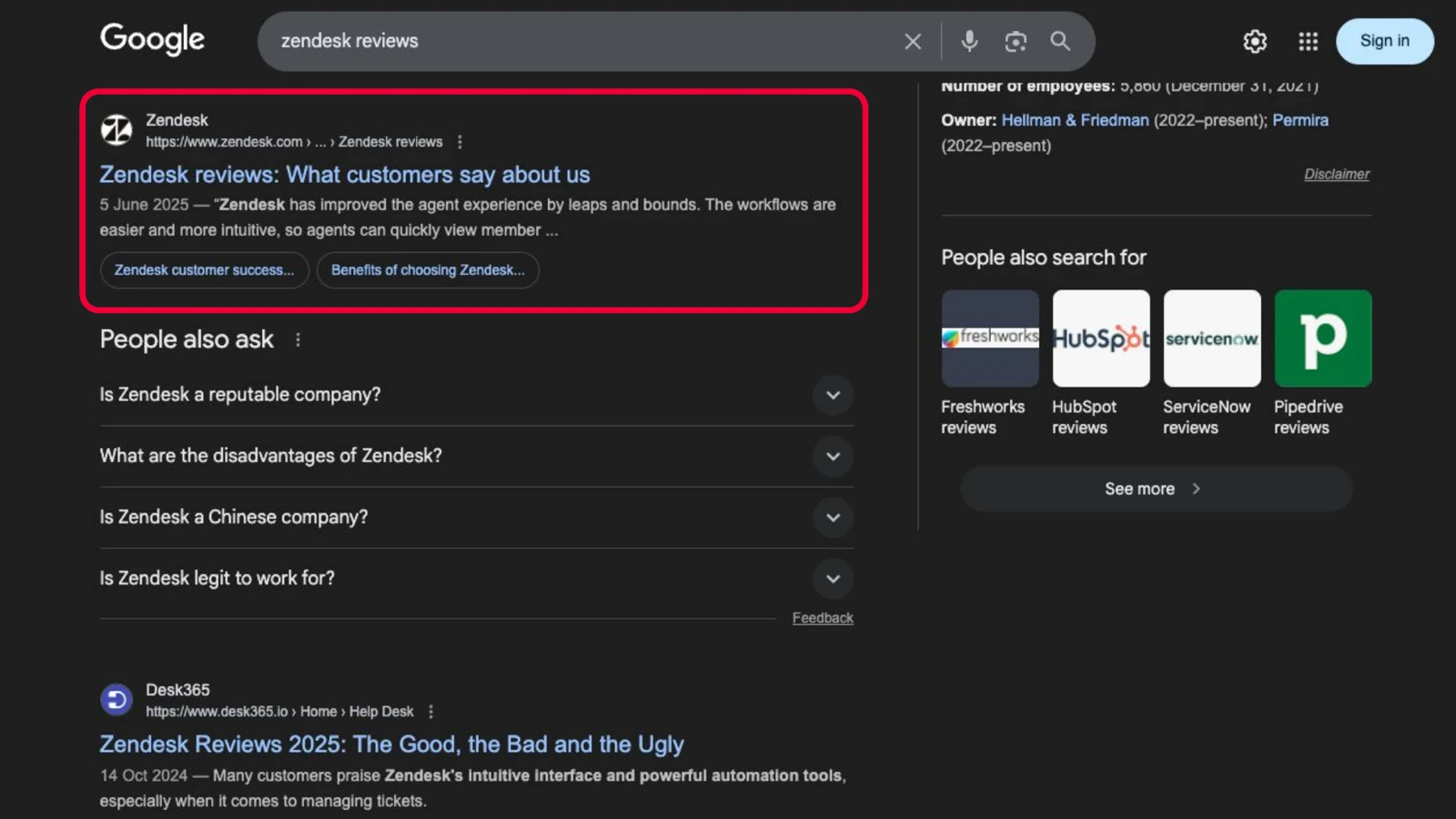
Zendesk owns its own reviews query instead of leaving it to G2
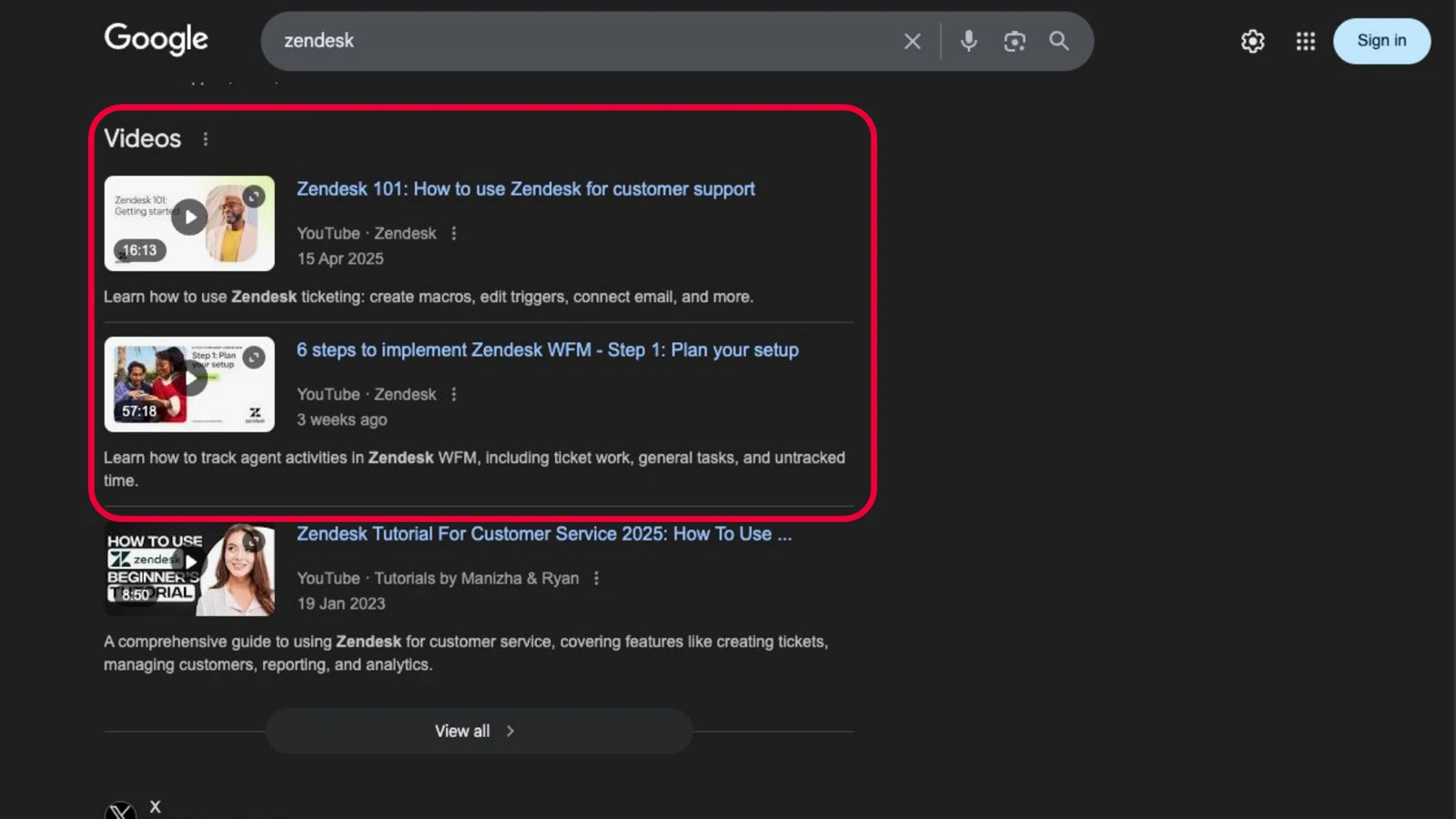
Same brand, a different SERP feature, still theirs
One quick win: create a page for “your brand + reviews.” Don’t leave it to Trustpilot or G2 to own this brand SERP and control the narrative.
Then there’s the classic brand-vs-competitor search. There’s only two people who are the top authorities for these terms. Don’t let your competitor have all the fun.
And when people go to ChatGPT, they answer questions, not keywords. Review your brand SERP and your competitors’, see what questions are actually being asked, and write the official answer for your brand.
Owning your brand story isn’t only about the traditional SERP either: it’s about training AI search on your truth. Users are asking deeper questions than ever, which means you need to stop thinking in keywords and start creating content that covers the key attributes of your brand.
Train AI on your truth:
- Best for
- Known for
- Pros & cons
- Feature comparison
- Pricing
- Ease of use
- Customer base
- Support
- Ratings
- Shipping
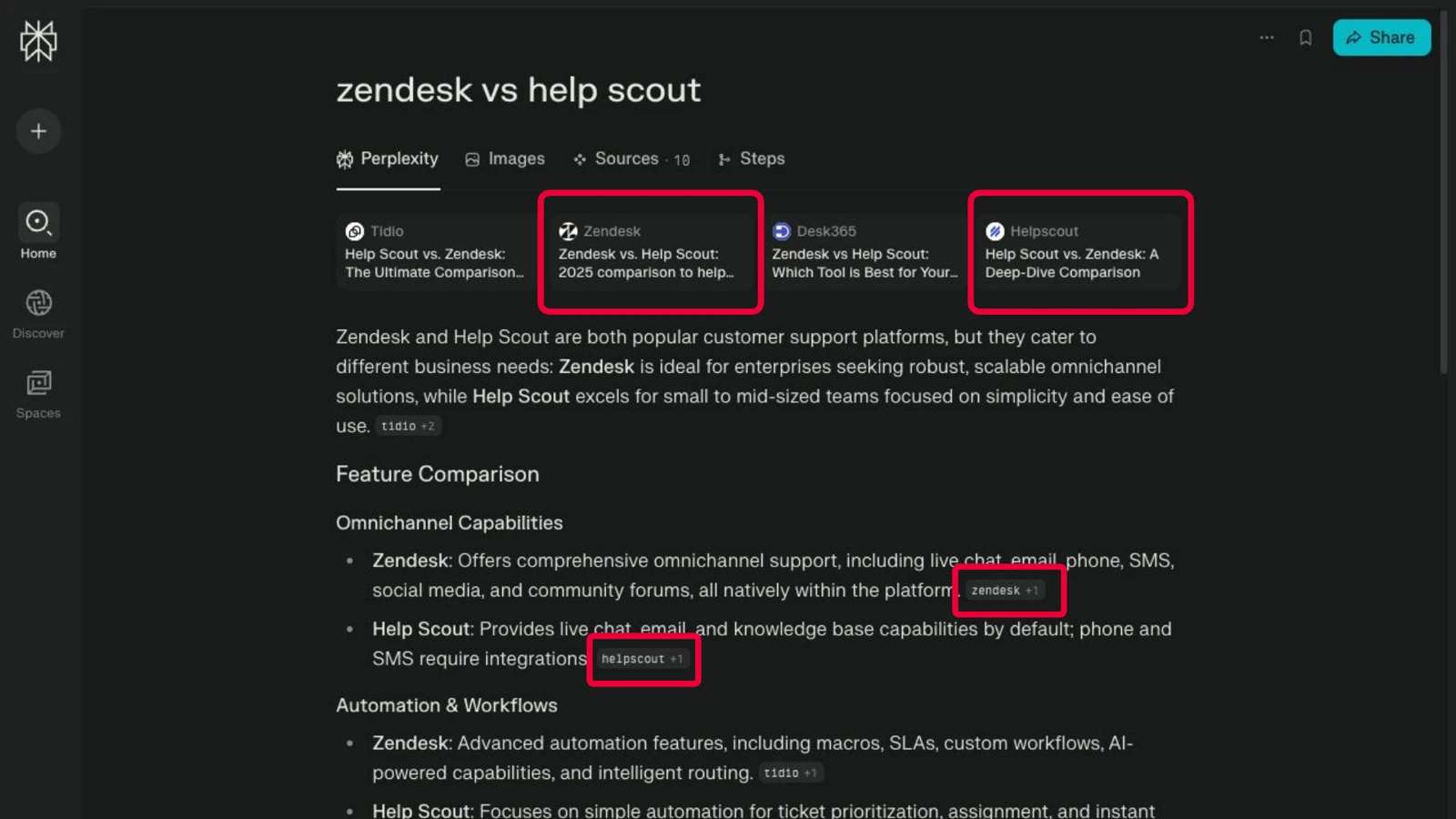
The whole argument in one screenshot: the AI is quoting Zendesk’s own page back at you
Here’s proof it works: from a “Zendesk vs Help Scout” comparison page, Perplexity, ChatGPT, Gemini, and Grok all cite Zendesk and Help Scout’s own content as sources for the query. Make sure AI learns from you, not just others.
Last but not least in this section: control what you can. When people Google you, they go beyond the first link: they’re looking for the dead bodies on page two. The good news is these results are largely within your control, and it matters even more in the AI search era, because these bots will go digging.
Control what you can:
- Brand references
- Social profiles
- Review platforms
- Business listings
- Niche directories
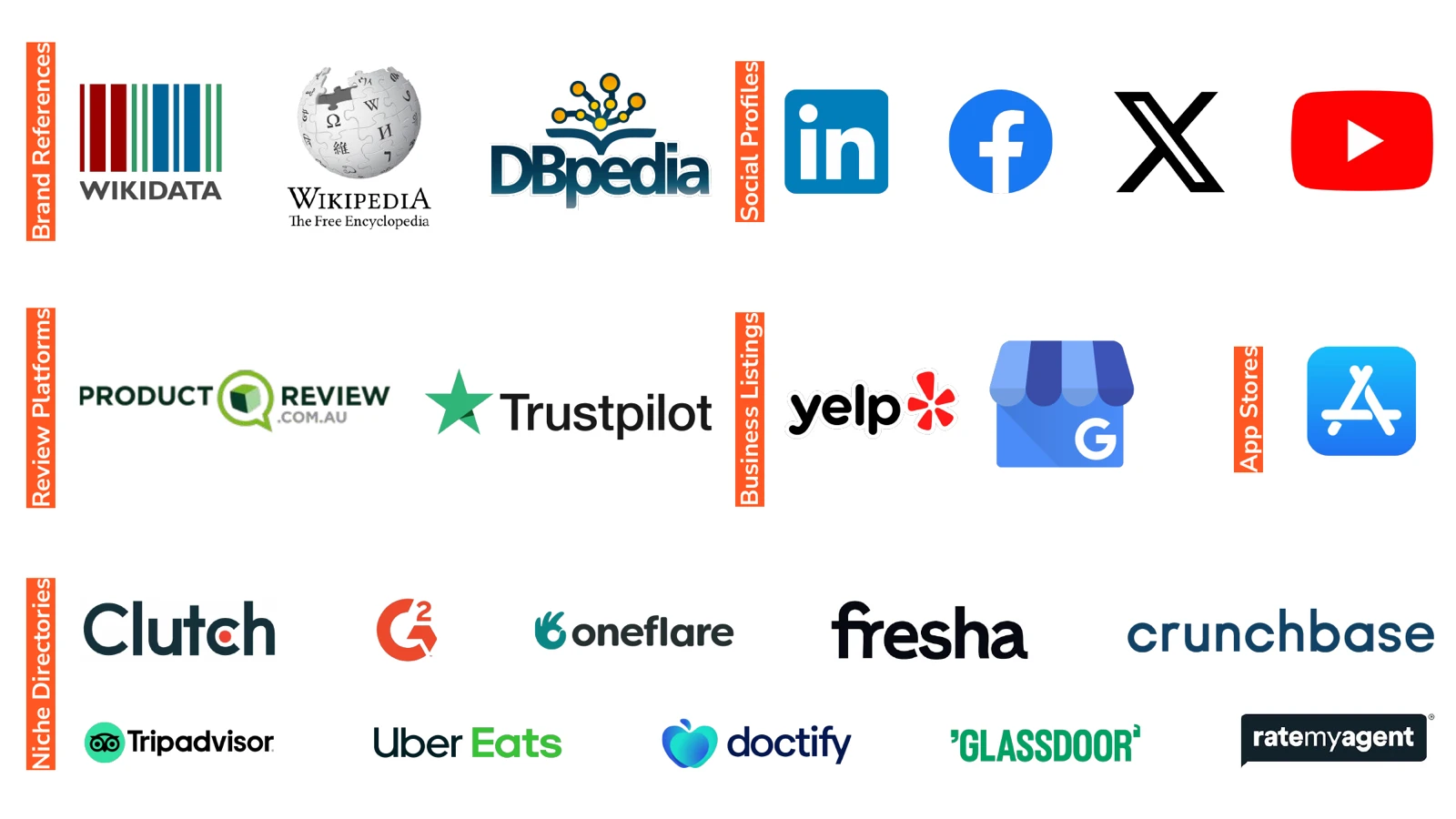
Your homework list. Claim these before something else fills the gap for you
Update your Wikipedia page. Claim every social media profile. Claim every business listing. Make sure your information is consistent across directories.
Truth #2: Everything Is a Search Engine
If people are searching for things, stop thinking about Google. SEO has never just been about Google, and it never will be. Your audience is searching everywhere: it’s just their intent that changes by platform.
They go to Google for research, YouTube for in-depth reviews, TikTok and Instagram for style inspiration, Pinterest for planning, Reddit for honest opinions, and ChatGPT for direct comparisons. A running shoe brand might show up in a Google AI Overview for “best running shoes for flat feet,” a YouTube review for “Nike Invincible 3,” a TikTok or Instagram post on “how to style Nike Dunks,” a Pinterest board for “wedding shoes for men,” a Reddit thread asking “are Allbirds worth the money,” and a ChatGPT comparison of “Hoka Clifton 9 vs Brooks Ghost 15”, all in the same week, for the same audience.
You need to be on the right platform, in the right format, for the right intent. I know that’s easy to say. So how do you actually show up everywhere? Repurposing content for distribution is the key.
Don’t forget distribution:
- Long-form articles
- Short-form articles
- Long-form video
- Short-form video
- Infographics
- Images
- Quotes
- Audio
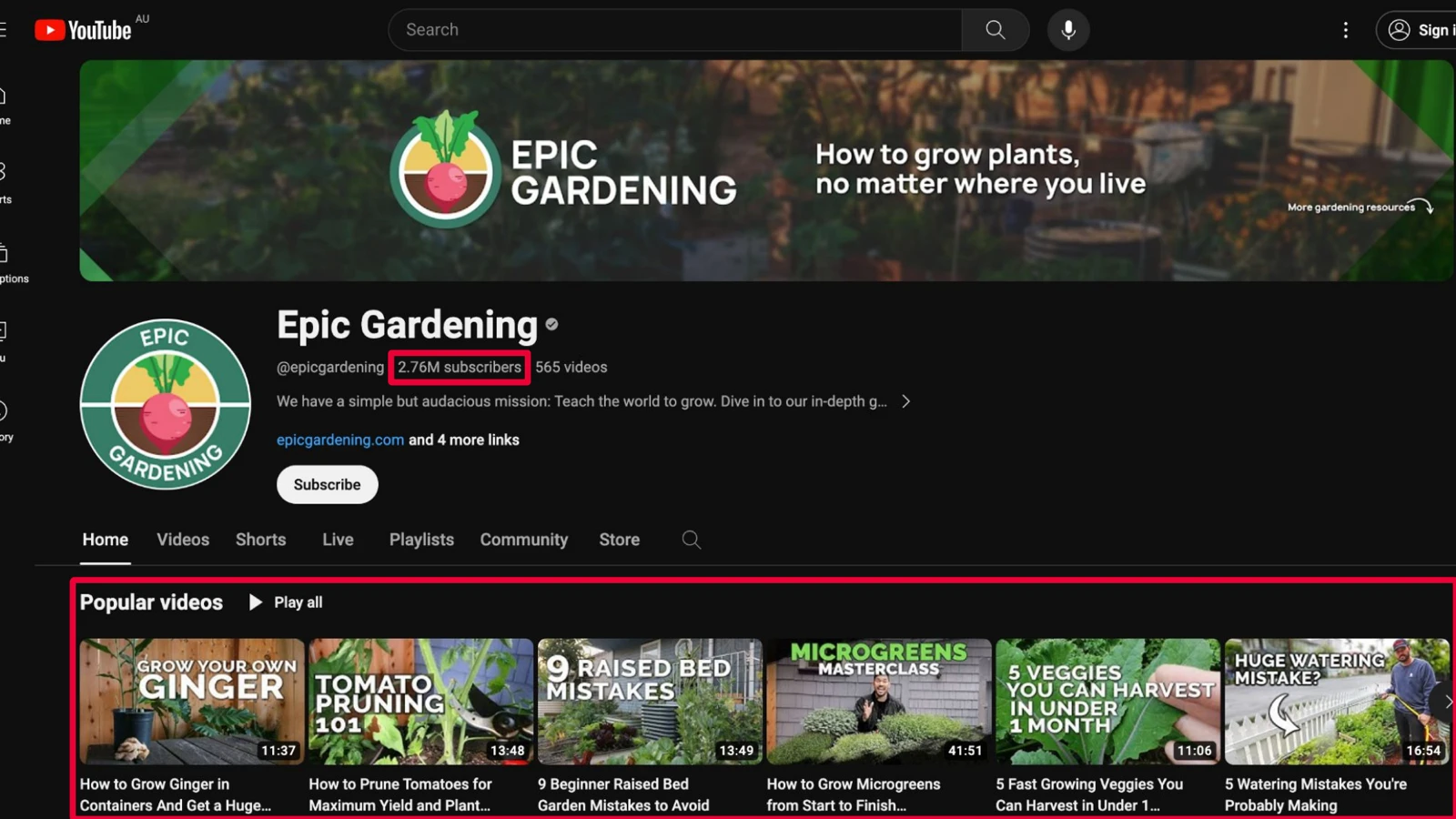
It starts here, with the long-form video
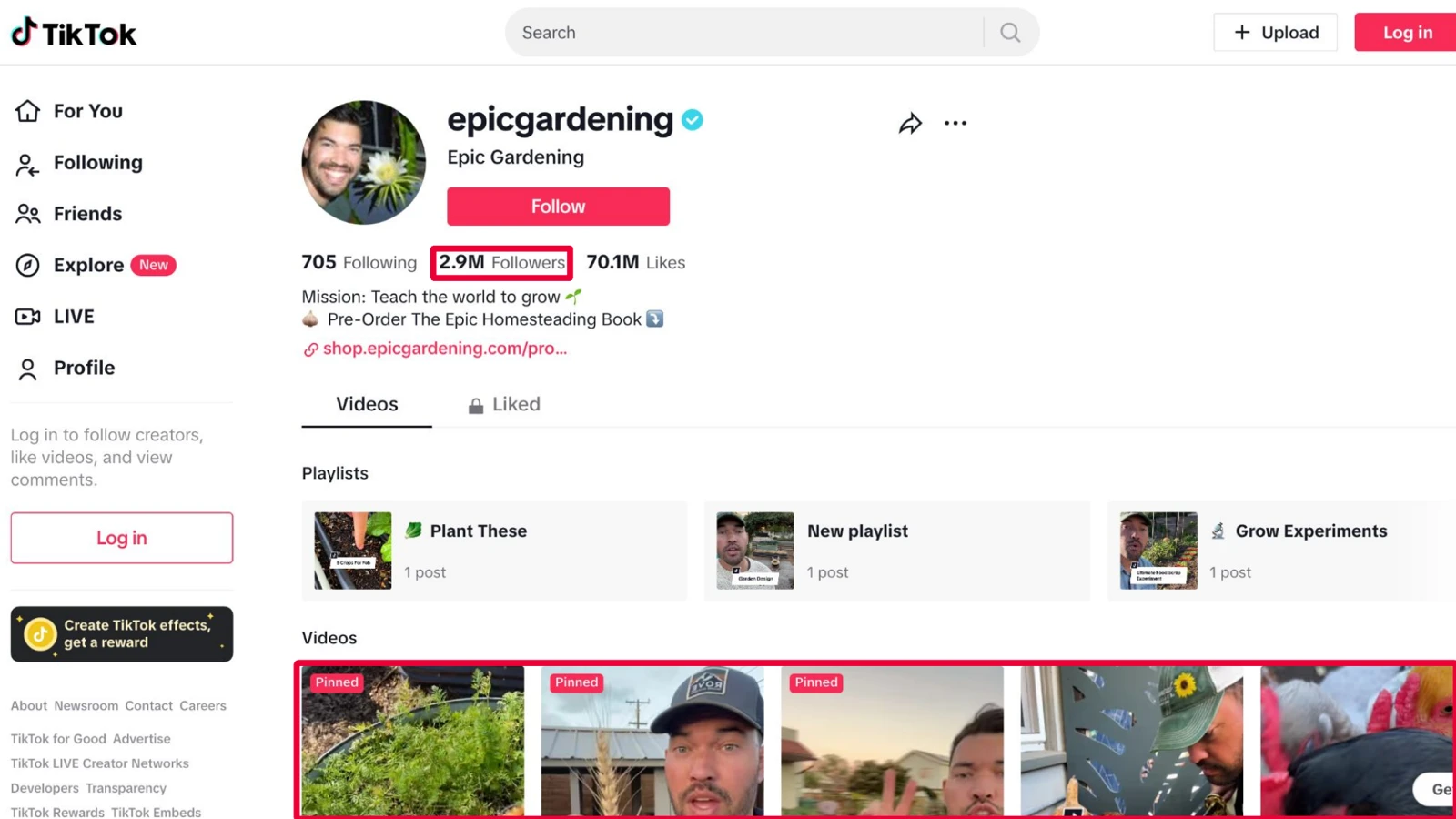
Same footage, cut down for a completely different audience
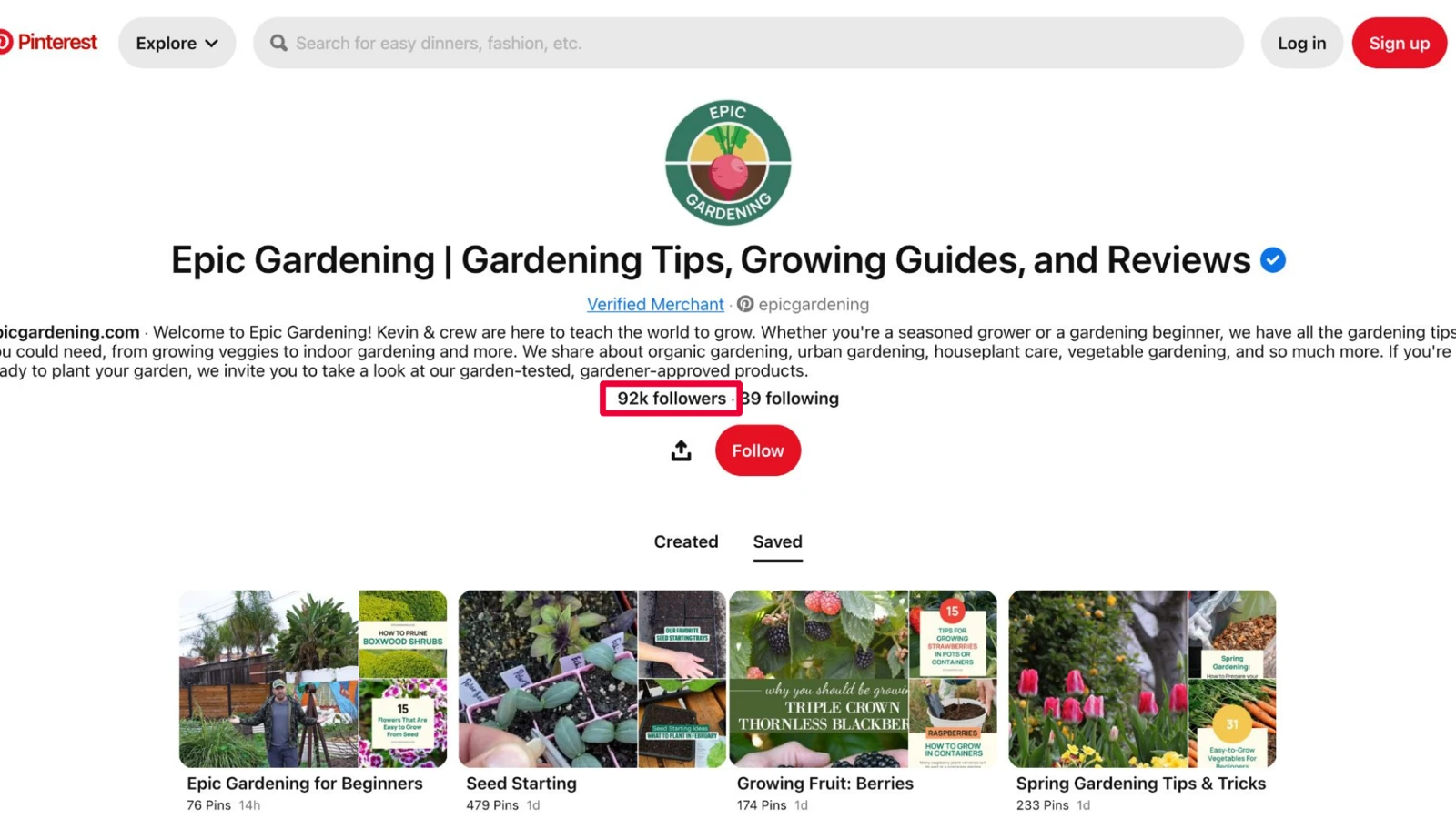
And the stills become pins that keep sending people back for years
Epic Gardening is a genuinely great example of this. They create informative, engaging long-form videos. They break those videos up and take the unique insights and imagery from them and embed them in articles. They turn the videos into shorts for TikTok. They take the images and turn them into carousels, reels, and stories for Instagram and Facebook. And they turn the same material into infographics for Pinterest, sending people back to the original articles on their site.
Does it actually work? Epic Gardening runs on YouTube (2.76 million subscribers), TikTok (2.9 million), Instagram (1.2 million), and Pinterest (92,000). Their branded search now sits around 8,100 searches a month. That’s not an accident. That’s what years of consistent repurposing looks like once it compounds.
Truth #3: Content Is Now a Commodity
Generic content is now a commodity. It’s deeper expertise, unique perspectives, and original insights that make your brand stand out online.
Sure, ChatGPT can tell you how to make a cabinet. It’ll get the materials, the tools, and some reasonable instructions in there. But compare that to an Instructables guide written by an actual experienced carpenter: real images, real video, actual opinions, questions from real people who tried it themselves.
AI might be able to replicate information, but it cannot replicate experience.
Pillar 2. Context: Be Understood Everywhere
Content will get you found, but context will get you understood. It’s not enough to exist online: algorithms need to understand where you fit in the puzzle.
Truth #4: Relevance Is the New Authority
It used to be all about PageRank: who linked to you, how many backlinks you had, your domain rating. Today, what matters most is relevance. Algorithms care less about the size of your site and more about the content that mentions you.
Here’s an example that’s stuck with me from researching this space: Rite Plumbing and Heating, a small New York plumbing outfit, ranks second for “plumber nyc”, above Curbed, Roto-Rooter and NYC.gov, and only behind Yelp’s directory page. They’re also quoted as the expert voice in Wirecutter’s guide to plunging a toilet. I can’t prove the citation caused the ranking, but a contextually perfect mention on a page that authoritative is the kind of signal that’s hard to buy.
Relevance is the new authority.
Truth #5: Consistency Creates Relevance
Context isn’t just about off-page signals. It’s about how consistent you are with your own content. One isolated article won’t build relevance. A pattern of content around the same theme will.
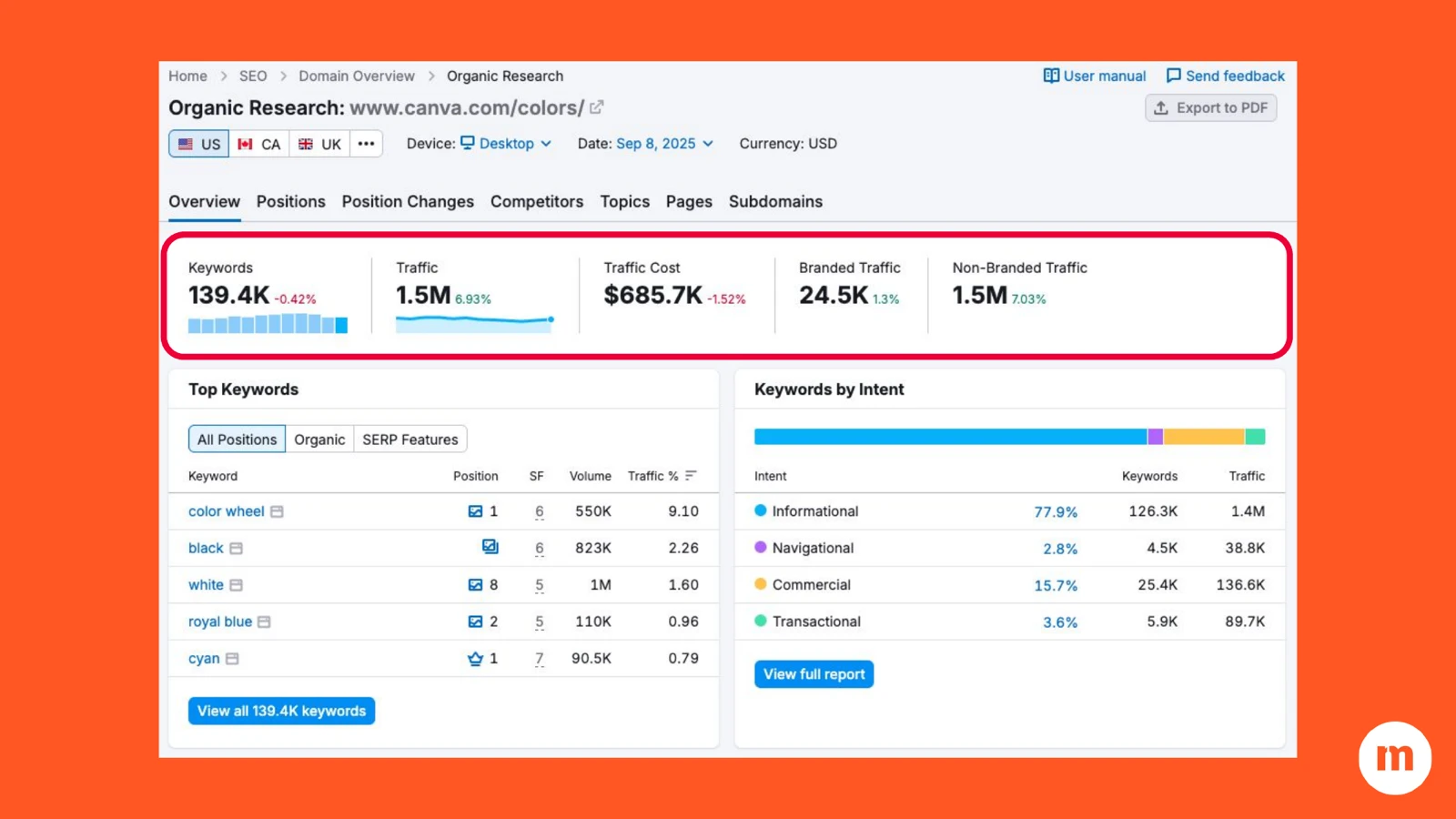
One cluster on colour theory, out-performing most entire websites
Take Canva. They didn’t just post once about colour theory; they built an entire cluster of more than 3,000 pages around colour palettes and design. That consistency built topical relevance at scale: 1.5 million visits a month, 139,400 keywords ranking, and an estimated $685,700 in traffic value, all tied back to a theme that fits naturally with their brand as a design tool. They didn’t just compete on colour content. They dominated it.
Consistency creates relevance.
Truth #6: Bots Have No Common Sense
Bots don’t think like humans. We read between the lines. We understand sarcasm. We infer meaning from context. Algorithms don’t. They process patterns and signals. If you leave gaps, they can’t fill them. They need clarity, and that’s why structure matters.
Think about bots as lazy readers. Don’t make them dig.
Structure for scannability:
- Headings as signposts
- Modular blocks (short paragraphs)
- Prioritise readability
- Answer first, explain later
This is where passage indexing comes in: algorithms reference passages, not just pages. If every paragraph stands on its own as a complete answer, you give algorithms bite-sized clarity, and they reward you for it.
Next: eliminate ambiguity. Be painfully explicit. Cut the fluff, and speak the language of the bots.
Eliminate ambiguity for AI agents:
- Be painfully explicit
- Remove irrelevant fluff
- Speak their language (schema)
Schema, FAQs, and step-by-step instructions give algorithms clear context to follow, so bots aren’t left guessing what you mean.
Here’s a way to think about it: imagine asking a human to make you a cup of tea. You might say “milk and sugar”. You wouldn’t need to tell them to boil the kettle or grab a mug first. A bot needs all of that spelled out. You’d have to spoon-feed it the content.
The same logic applies to your website. Don’t just say “check out”: write a help centre article that details every single step of the process, because it looks different for every brand. And this isn’t just for human users. It’s for the coming wave of AI agents that will perform tasks on people’s behalf. Explicit instructions make your content LLM-friendly.
Pillar 3. Confidence: Be Trusted Everywhere
You can have the perfect content and flawless context. But without confidence, without trust, you’re just another website. Confidence is about what makes both people and algorithms choose you when there are 50 other options.
Truth #7: Transparency Builds Trust
Users and bots both want to know the same thing: who are you, and can I rely on you? Clear About and Team pages, visible contact details, and policies in plain sight aren’t just formalities or legal requirements. They’re trust signals. Show your human side: who’s behind the brand, and how people can reach you if something goes wrong.
Tell them what you’re about:
- About Us
- Team
- Contact info
- Site policies
NerdWallet does this brilliantly. Their “how we make money” page tells you exactly how they evaluate products and confirms that staff bonuses aren’t tied to revenue. That transparency builds authority, and it shows you can be trusted.
Trust also comes from showing your content is current, sourced, and written by real experts. Bylines, dates, disclosures, named reviewers: these signals tell both bots and users that this isn’t content built for clicks. It’s content you can count on.
Why they can trust you:
- Current information
- Transparency
- Disclosures
- Publishing principles
- Sourcing
- Author background
- Expert reviewers
- Fact-checked
NerdWallet’s Best Credit Cards page is a good live example: it’s obvious at a glance that the content is current, reviewed by named experts, and appropriately disclosed.
Truth #8: Trust Is Built Through Actions, Not Words
The most powerful trust signals are earned, not claimed. They’re moments people talk about when you’re not in the room.
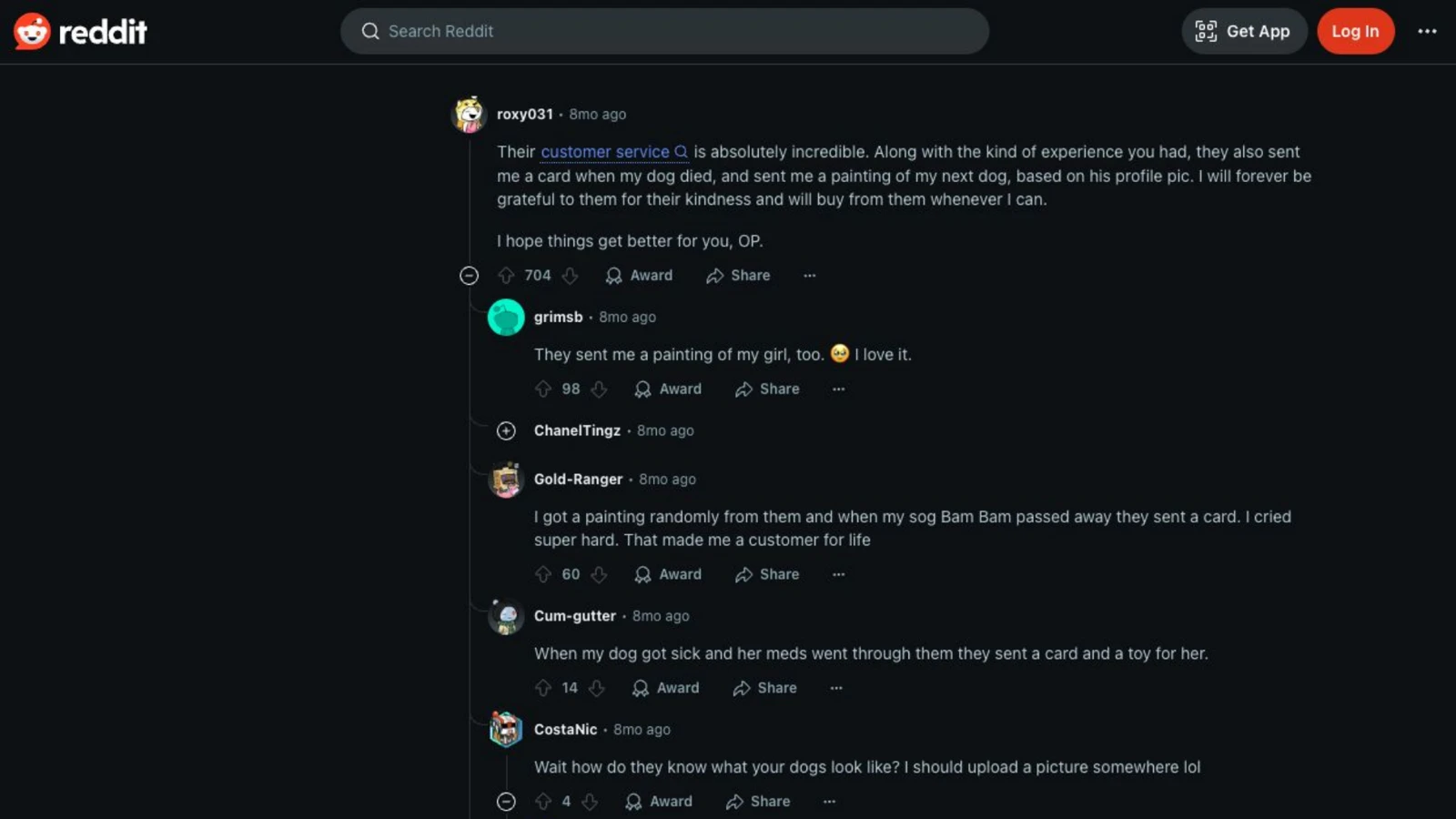
Nobody was asked to post any of this
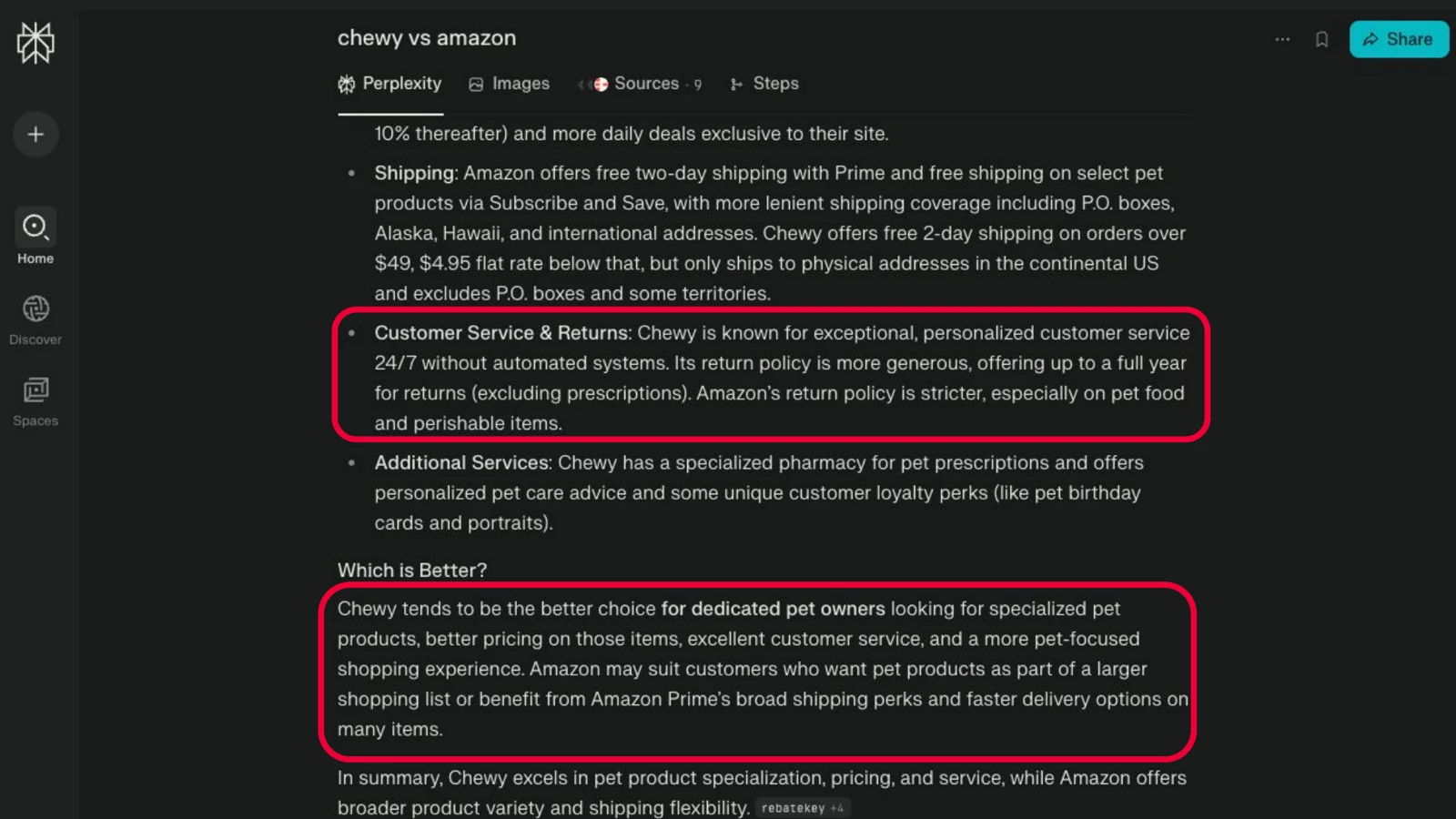
And later the AI repeats it back as fact, up against Amazon
Chewy is the example I keep coming back to for this. When a customer’s pet dies, Chewy sends flowers. Chewy also sends hand-painted pet portraits, more than a thousand a week, to customers generally rather than only on adoption, and worked out early that recipients post them, which is to say the gesture is the advertising. Customers talk about it on Reddit. Those posts get shared on X. They turn into news articles: one customer’s tweet about the flowers pulled 600,000 likes and turned into coverage in Fortune, the Boston Globe, TODAY and Newsweek.
One tweet, unprompted, turned into national news coverage. That’s not customer service. That’s a trust engine.
The real unlock is that if you build a business worth talking about, algorithms notice too. It doesn’t just win hearts; it wins rankings. Even against a giant like Amazon, Chewy holds its own in trust comparisons, because the actions back it up.
Truth #9: Your Silence Is Their Story
The flip side: if you don’t reply to reviews, if you let misinformation spread unchecked, you leave a vacuum. Algorithms hate a vacuum. They fill it with whatever they find. Your silence lets others write your brand story for you. And once that story sticks, it’s hard to take back.
Take an unanswered negative review. No reply, no acknowledgement. And to anyone reading it, including an algorithm trying to work out whether your brand can be trusted, the silence reads as confirmation. Whatever the reviewer said must be true, because nobody came back to say otherwise.
Now compare that to a business that replies to a one-star review politely, apologises up front, and gently corrects any misinformation in the post. Same star rating. Completely different story being told to everyone who reads it next, human or bot.
Your silence is their story.
The Flywheel: Why This Isn’t a Checklist
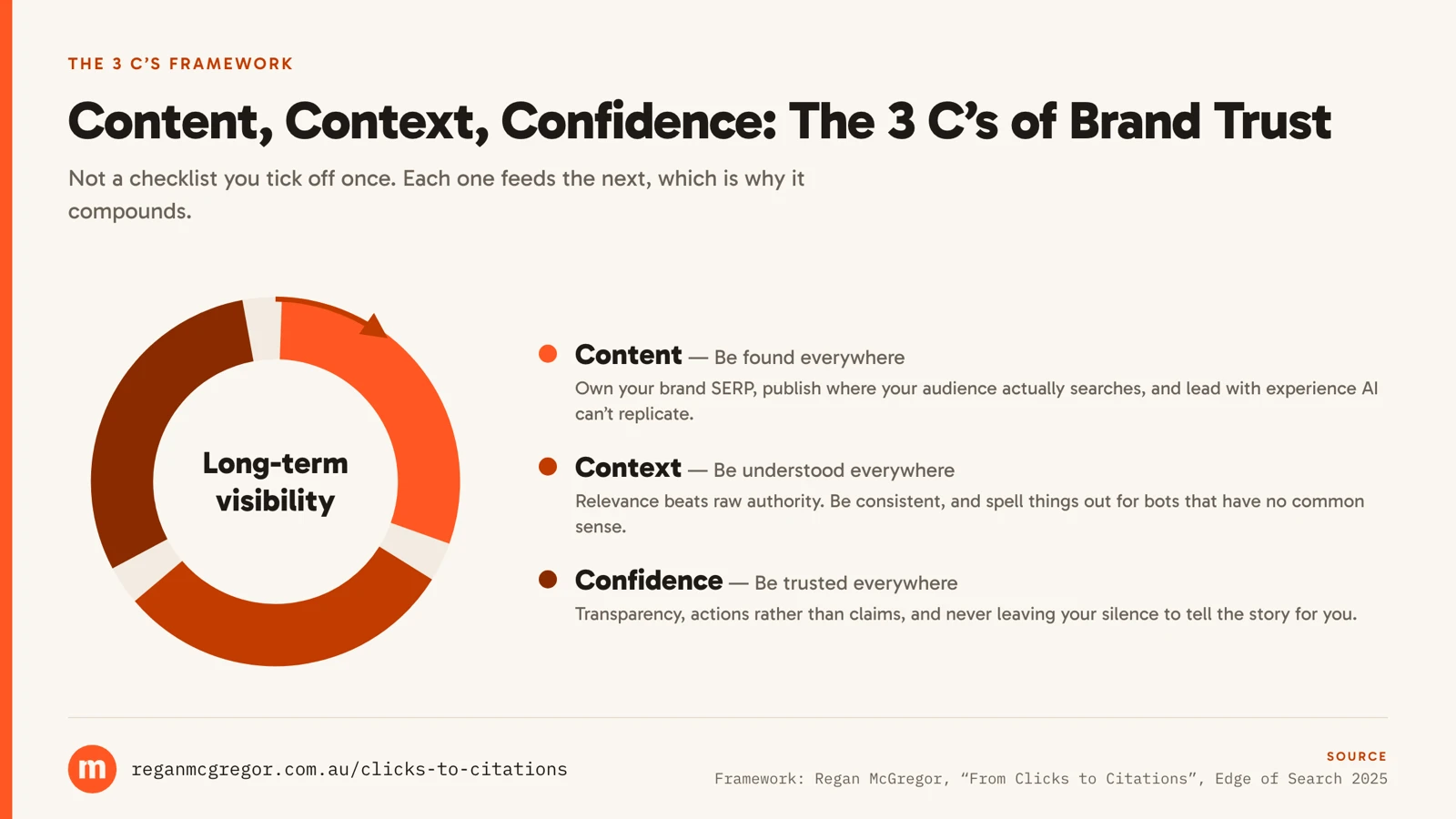
Each one feeds the next, which is why it compounds
These three pillars aren’t a checklist. They’re a flywheel.
Great content creates the material for context. Clear context builds the confidence that earns trust. And that trusted audience amplifies your content, making the next cycle stronger than the last.
It’s not linear. It’s a compounding loop.
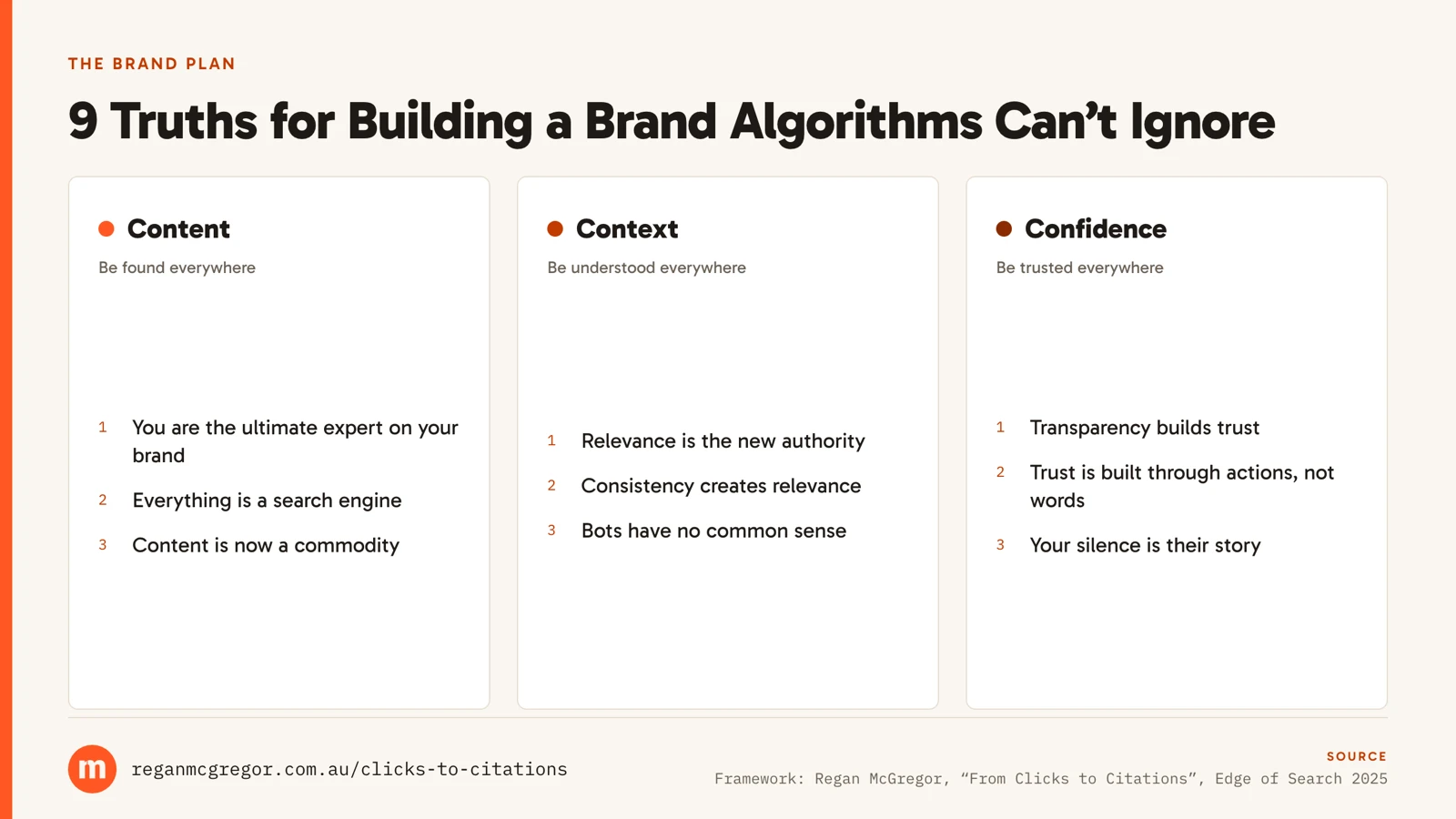
The whole framework on one page, if you only save one thing
So here’s the blueprint, condensed: you are the ultimate expert on your brand. Everything is a search engine. Expertise beats commodity content. Relevance, not raw authority, wins. Bots only understand what you spell out for them. And most importantly, your transparency and your actions are what build lasting trust online.
Your 3 Actions Today
If I can leave you with three things to do today to improve your content, context, and confidence, it’s this.
- Claim and update every business listing. A simple way to find them all: search your brand name, click the three dots on your website’s result, and look for “About this result” or “About this brand.” It’ll list everywhere you’ve been reviewed, every news article you’re mentioned in, and every social profile linked to your brand.
- Start answering real questions about your brand, even the ones that aren’t sitting in “People Also Ask” yet. Think about what people actually want to know. Stop hiding your pricing. Be clear about who you serve and who you don’t.
- Monitor and respond to every review, positive or negative. Show people you care about your business and about them.
These steps are small. But together, they train both users and algorithms to trust you.
So, stop chasing algorithms. Start building a brand they can’t ignore, because long-term visibility doesn’t come from tricks. It comes from trust.