How to Find a Profitable Ecommerce Niche With AI Agents (Free Prompts)

Most guides on how to find a profitable niche hand you a recycled list of product categories or tell you to check Google Trends and follow your passion, which means you only discover the economics of your ecommerce niche after you’ve built the store. Looking at search volume and glancing at page one skips the two problems that quietly kill new stores: traffic that never turns into money, and a supplier base or results page where someone bigger will always undercut you. If you want to learn how to pick a niche on evidence rather than guesswork, you can write your scorecard up front and get AI agents to measure thirty ideas in parallel, leaving you with a ranked scorecard and the numbers behind every score.
This is the first step in the Slack Side Hustle, where I build an online store from scratch and automate it until it runs from a Slack sidebar. Before any of the automation, you need a niche worth automating, so that’s where we start.
What you’ll end up with
When I ran this across about 30 Australian product categories, the agents pulled keyword volumes, Domain Ratings, link counts, street discounts and supplier terms into one research file per niche, and then scored each file against a fixed rubric. Instead of a gut feel about what might sell, the output was a single ranked table that separated genuine openings from crowded traps and zero-demand deserts before I spent a dollar on stock or a domain name. Categories that looked wide open on Google turned out to have 10 searches a month, whereas dull trade categories had weak stores earning thousands in organic traffic value.
| Niche | Money proofs | Beatability | Value per visit (US$) | Weighted score | Verdict |
|---|---|---|---|---|---|
| Infrared sauna and ice bath | 3 | 4.0 | 0.60 to 0.90 | 3.74 | Opportunity |
| Prosumer CCTV and accessories | 3 | 3.7 | 0.75 to 1.08 | 3.37 (distributors sell retail) | Opportunity |
| Safety signage | 3 | 4.5 | 0.70 to 1.36 | 3.23 | Opportunity, made to order |
| Ready-made blinds | 3 | 2.5 | 1.36 to 1.88 | 3.23 | Contested |
| Consumer spy gear | 2 | about 4.0 | about 0.53 | 3.22 | Opportunity |
| Workwear and PPE | passed | 3.9 | 0.46 to 1.36 | 3.15 (commodity range) | Opportunity |
| Ceiling fans and lighting | 3 | 3.7 | 0.18 to 0.57 | 2.73 (commodity range) | Opportunity on paper, weakest margin |
| Counter-surveillance equipment | 0 | specialists only | n/a | not scored | Desert |
| Graphics cards (control) | money exists | 2.2 | n/a | not scored | Contested, as expected |
These scores came from an earlier version of the scorecard, with the same weights, penalties and verdict matrix. The score anchors in the published scorecard were written down afterwards, so a rerun won’t match to the decimal.
The six boxes
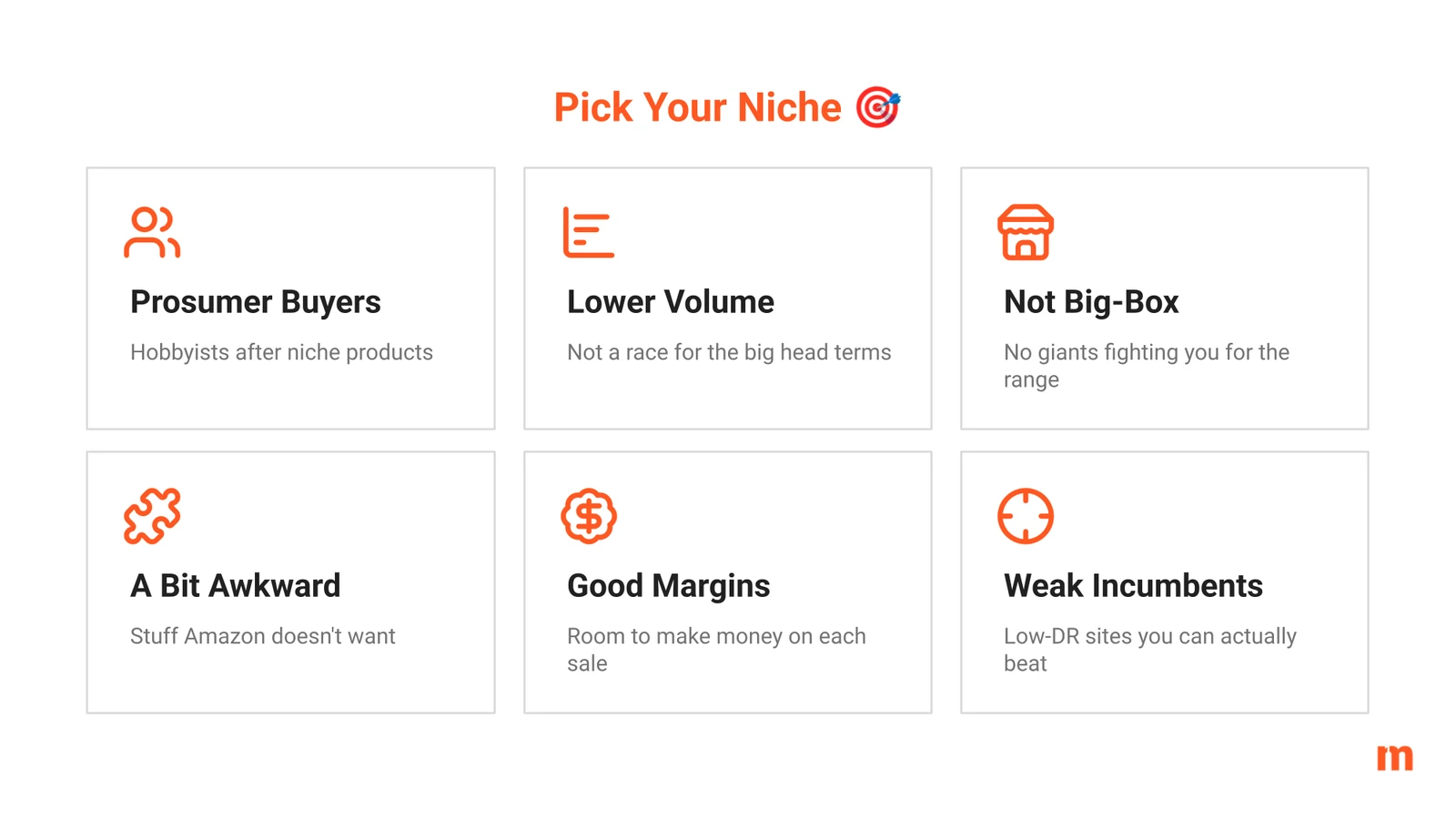
These are the six things I look for in a niche. Look, it doesn’t have to tick every box, but the more the better. What stops you talking yourself into a bad idea is turning each box into numbers an agent can pull from an SEO tool and live store pages:
| Box | What it means | What the agent measures |
|---|---|---|
| Prosumer Buyers | Hobbyists after niche products | Value per visit, spec and brand-led search volume, and enthusiast communities |
| Lower Volume | Not a race for the big head terms | Combined search volume and traffic potential across 4 to 6 seed keywords, plus the 5-year trend |
| Not Big-Box | No giants fighting you for the range | How many organic slots on page one belong to marketplaces and big-box retailers |
| A Bit Awkward | Stuff Amazon doesn’t want | Amazon organic and sponsored listing counts, parcel size and weight, licences, and ad restrictions |
| Good Margins | Room to make money on each sale | Street discount against manufacturer RRP, stores sharing the same SKU, and open trade suppliers with feeds |
| Weak Incumbents | Low-DR sites you can actually beat | Lowest DR, median DR, pages with 5 or fewer referring domains, and traffic value of DR 35 or under sites |
What you need
You need Claude Code on a Pro plan or higher (US$20 a month billed monthly, US$17 billed annually), which includes subagents to research five niches at once. Connect either the Ahrefs MCP server on Ahrefs Lite or higher (US$129 a month) or the DataForSEO MCP server on DataForSEO pay-as-you-go pricing (US$50 minimum top-up, US$1 trial credit), plus Firecrawl (free for 1,000 credits a month, Hobby US$19 for 5,000) and an afternoon while the agents run. Other MCP-capable agents (Codex, Gemini CLI, Cursor) can run the same prompts.
How it works
- Write the scorecard first. Save
scorecard.yamlwith your country, thresholds, dimension weights and penalty multipliers before pulling any data so you can’t quietly move the goalposts later. - Generate 20 to 30 candidates. Run Prompt 1 to combine category buckets, weak-incumbent mining, SERP harvesting and wholesale distributor checks into
candidates.md, including one negative control like graphics cards, then cut any niche you wouldn’t sell. - Send one research subagent per niche. Run Prompt 2 so parallel subagents verify the kill checks, test the money gate before checking the results page, and save buyer, SERP, Amazon, pricing and supplier data to
research/<niche-slug>.md. - Score the evidence in a fresh session. Open a new chat and run Prompt 3 so the scorer reads the research files cold against
scorecard.yamlwithout remembering how the data was gathered. - Make the final call yourself. Weigh the top five finishers against your stock budget, workload and feed automation options, then apply for two or three trade accounts to verify real dealer margins.
Step 1: Write the scorecard before you pull any data
Honestly, plenty of bad niche decisions start with a product category you already like and whichever metric makes it look good. Writing your rules into a file before you pull any numbers forces every candidate through the same filter and makes any later rule adjustment visible.
When I ran my screen, my first money rule required a median CPC of at least AUD 1.00 across the seed keywords. Only 4 of the 30 niches cleared it, which was pretty telling, because it failed categories where specialist stores were clearly making money. The problem is where that CPC number comes from. Ahrefs, DataForSEO and even Google’s own Keyword Planner report what advertisers bid on text ads in Search, whereas product searches mostly make their money through Shopping ads, which that number doesn’t include. In categories Google restricts for ads, it’s low or missing altogether. Knives are a good example: hunting knife gets about 2,100 searches a month in Australia and shows no CPC at all in Ahrefs, yet extac.com.au, a DR 17 knife and outdoor store, gets about 9,000 organic visits a month worth about US$1,560. I replaced that rule with a check for a weak site (DR 35 or under) already earning at least US$2,000 a month in organic traffic value, and wrote the date and reason into the scorecard’s changelog so the change was explicit instead of a quiet goalpost move.
Before the scorecard checks demand or competition, it runs two kill checks that eliminate a niche regardless of its score. The products must be legal to sell in your country (legality of use or installation licensing doesn’t kill a niche, since a shopper can buy a ceiling fan online and pay an electrician to install it), and your store platform and payment provider must allow the category under Shopify’s Acceptable Use Policy and the Shopify Payments restricted businesses list.
SERP beatability carries the most weight at 32%, and I won’t lie, that’s deliberate: if organic search is your only channel, a results page you can’t crack makes everything else irrelevant. Margin (20%), demand (18%) and supply (15%) make up the core commercial checks, while freight (8%) and moat (7%) reward easier parcels and defensible friction. Save this file as scorecard.yaml in your working folder and edit the country, marketplaces and big-box lists for your market:
# Niche scorecard
#
# Write this before you pull any data, and change it only here, with a dated
# note saying why. Every score the agents record carries the version it was
# computed under, so a change of rule is visible instead of a quiet goalpost move.

version: 1
changelog:
  - version: 1
    date: YYYY-MM-DD
    note: Set before any data was pulled.

market:
  country: au                # the country code your SEO data tool uses (au, us, gb, nz...)
  language: en
  currency: USD              # Ahrefs and DataForSEO report money in USD
  channel: organic           # organic search only, no paid ads assumed
  keywords_per_niche: 6      # 4 to 6 seed keywords per niche; one results page is a thin sample

# Run before anything else. A niche that fails one is out, whatever it scores.
kill_checks:
  legal_to_sell: >
    Documented illegality of SALE in your country kills a niche. Legality of
    use doesn't, and neither does installation licensing (a customer can buy a
    ceiling fan online and have an electrician install it).
  platform_allowed: >
    Your store platform and payment provider allow the products (Shopify's
    Acceptable Use Policy and the Shopify Payments restricted businesses list).

# The money check runs BEFORE the results-page check, so a niche that only
# looks good on the SERP dies here.
money_gate:
  rule: pass at least 2 of 3
  proofs:
    volume:
      metric: total monthly searches across the niche's seed keywords, from one tool
      threshold: ">= 3000"
    weak_incumbent_earning:
      metric: >
        the highest monthly organic traffic value (USD) of any site in the
        niche with a Domain Rating of 35 or less
      threshold: ">= 2000"
      why: >
        A weak site already earning proves the niche makes money AND that you
        can win it without authority. Use this, not CPC: shopping-intent terms
        are monetised through Shopping rather than text ads, and ad-restricted
        categories show suppressed or no CPC.
    trend:
      metric: >
        5-year Google Trends for the two biggest keywords, average of the last
        52 weeks against the first 52; use the lower of the two
      threshold: "not below -25%"
      note: Trends gives a relative index. Use it to catch decline only.

# Out if the results page is already owned by marketplaces and big retailers.
marketplace_check:
  rule: out if marketplaces + big-box retailers hold 6 or more of the organic results on page one
  marketplaces: [amazon, ebay, etsy, temu, aliexpress, kogan, catch]   # edit for your country
  big_box: [bunnings, jb hi-fi, harvey norman, officeworks, big w, kmart, target]   # edit for your country

# Each dimension is scored 1 to 5. The six boxes feed them as shown.
# Scoring rules:
#   - Every clause in an anchor must hold. Give the highest anchor that fully holds.
#   - If the evidence sits between two anchors, give the half point (3.5).
#   - If the evidence is "not found", give 2 and mark the score provisional.
# The weighted score is out of 5.
dimensions:
  serp_beatability:
    weight: 0.32
    boxes: [weak incumbents, not big-box]
    measure: >
      Across the organic results on page one for every seed keyword: the lowest
      Domain Rating, the median Domain Rating, and how many ranking pages have 5
      or fewer referring domains. (Marketplace and big-box slots are the
      separate marketplace_check.)
    score:
      5: a site under DR 15 on page one for most keywords, and most pages on 5 or fewer referring domains
      4: a site under DR 25 on page one for most keywords, and median DR under 35
      3: median DR 35 to 45, and some pages on 5 or fewer referring domains
      2: median DR 45 to 60, and little under DR 40
      1: nothing under DR 45 on page one
  margin:
    weight: 0.20
    boxes: [good margins, prosumer buyers]
    measure: >
      Value per visit (traffic value divided by traffic) of the incumbents leads.
      Then move the score down one if street prices run 25% or more under the
      manufacturer's RRP (a store's own "was" price isn't an RRP), or if 10 or
      more stores sell the same SKU at much the same price.
    score:
      5: value per visit over USD 1.00
      4: value per visit USD 0.60 to 1.00
      3: value per visit USD 0.40 to 0.60
      2: value per visit USD 0.20 to 0.40
      1: value per visit under USD 0.20
  demand:
    weight: 0.18
    boxes: [lower volume]
    measure: >
      Total volume and traffic potential across the keyword set, and how much of
      it sits in the long tail rather than one head term.
    score:
      5: over 30,000 searches a month across the set, spread over many terms
      4: 10,000 to 30,000
      3: 3,000 to 10,000
      2: 1,000 to 3,000
      1: under 1,000
  supply:
    weight: 0.15
    boxes: [good margins]
    measure: >
      How many suppliers you can open an account with today (distributors with
      open trade accounts, brand dealer or stockist programmes, wholesale feeds,
      direct import) and whether stock and prices come as a feed you can automate.
    score:
      5: 3 or more suppliers, at least one with a stock and price feed
      4: 2 suppliers, one with a feed
      3: 2 suppliers, CSV or manual price lists only
      2: 1 supplier
      1: import only, or made to order
  freight:
    weight: 0.08
    boxes: [a bit awkward]
    measure: Typical parcel size and weight against the order value.
    score:
      5: fits a satchel
      4: small carton under 5 kg
      3: standard carton under 20 kg
      2: large or long carton, or over 20 kg
      1: pallet or two-person delivery
  moat:
    weight: 0.07
    boxes: [a bit awkward, prosumer buyers]
    measure: >
      Friction most competitors haven't cleared (taboo but legal, licences,
      fiddly to choose, few ads allowed) and an enthusiast community with its
      own forums and vocabulary. A compliance mark every competitor already
      has isn't a barrier.
    score:
      5: a barrier most competitors haven't cleared, and an active enthusiast community
      3: one of the two
      1: neither

# Multiply the weighted score by each one that applies (they multiply together).
penalties:
  distributors_sell_retail: 0.85   # the suppliers you could open an account with also sell to the public online and rank
  commodity_range: 0.85            # many stores run the same feed on the same SKUs
  payment_risk: 0.70               # payment providers restrict or reserve funds for this category

# Separates "weak because nobody looked" from "weak because there's nothing to win".
verdict:
  opportunity: money proofs >= 2 and serp_beatability >= 3.5
  contested: money proofs >= 2 and serp_beatability < 3.5     # park it
  desert: money proofs <= 1 and serp_beatability >= 3.5       # out
  irrelevant: money proofs <= 1 and serp_beatability < 3.5    # out

# Include one niche you already know is hard. If it doesn't come out at the
# bottom, the rubric is wrong.
negative_control: graphics cards
Step 2: Generate 20 to 30 niche ideas
So rather than asking an LLM for store ideas, start where weak stores are already making money. Prompt 1 builds a list of 20 to 30 candidates using four discovery methods so you don’t rely on guesswork.
In my run, the first method (breaking buckets like prosumer and hobby gear, trade and workshop supplies, bulky items, awkward or taboo products and accessories into product categories) provided necessary scaffolding without surfacing any surprises. The third method, harvesting SERP competitors from seed keywords, generated extra seeds quickly but returned metrics too shallow to judge on without a second pass. The fourth method, supply-side inversion where you start from wholesale distributors and work back from their ranges, wasn’t run, and I noted afterwards it was as the method most likely to reorder the list, which is why it sits in Prompt 1.
For the most part, though, weak-incumbent mining carried the round. Searching Ahrefs for Australian stores at DR 35 or less with 3,000+ monthly organic visits and snowballing through their organic competitors uncovered 9 clusters and about 45 measured domains that a normal brainstorm wouldn’t find: discountsafetysignsaustralia.com.au (DR 1.6, about 2,550 visits a month, about US$2,000 a month of traffic value), australiansafetysigns.net.au (DR 4.1, about 4,170 visits, about US$2,930), powerpointsandswitches.com.au (DR 5, about 4,790 visits), electrotraders.com.au (DR 6, about 5,150 visits) and safetysigns.com.au (DR 10, about 10,240 visits, about US$7,160). Across every cluster measured, no category leader sat above DR 48, and most had nobody above DR 35.
Prompt 1 also excludes contaminated keywords like smart switch (5,700 searches a month, mostly for Samsung’s phone-transfer app rather than light switches) and adds a negative control like graphics cards. Paste this into Claude Code from the folder that holds scorecard.yaml, after replacing the two lines in square brackets:
You're helping me find a niche for a new online store. Read scorecard.yaml in this folder first: it sets the country, the currency and the rules every niche will be scored against later.

About me: [what you know, what you like, what you've sold before, how much you can spend on stock]
Ideas I already have: [list them, or write "none"]

Build a list of 20 to 30 candidate niches for an ecommerce store selling physical products, using organic search only. Use four methods and say which method found each niche:

1. Buckets. Break these into specific product categories: prosumer and hobby gear, trade and workshop supplies, bulky or awkward-to-ship products, products that are legal but taboo or need a licence or compliance mark, and accessories that go with a bigger purchase.
2. Weak-incumbent mining. With the SEO data tool, find stores in my country with a Domain Rating of 35 or less that get at least 3,000 organic visits a month from product and category pages. For each one, pull its organic competitors and repeat once. Each cluster of stores is a niche. This method usually finds niches nobody would brainstorm, so spend the most effort here.
3. SERP harvesting. For 10 seed keywords from methods 1 and 2, list the stores ranking on page one (organic results only) and add any niche they reveal.
4. Supply side. Search for wholesale distributors in my country that offer open trade accounts or dealer programmes, and note the product ranges they carry.

For every candidate, record:
- niche name and 4 to 6 seed keywords a shopper would search (product terms, not brand names alone, and no term that means something else, like "smart switch", which is mostly a phone app)
- the method that found it
- the best weak incumbent found (domain, DR, monthly organic traffic, monthly traffic value in USD)
- one line on why it might fit me

Add one negative control: a niche you'd expect to be hard to win, like graphics cards.

Don't score anything yet. Save the list to candidates.md as a table, then tell me how many you found by each method and which ones I should cut before research because they fail a kill check in scorecard.yaml.
Step 3: Check the money before the results page
Once you’ve trimmed candidates.md down to categories you would actually sell, the research subagents test the money gate before they score the results page. Each niche must pass at least 2 of 3 proofs: 3,000 or more monthly searches across its seed keywords, a weak incumbent (DR 35 or under) with at least US$2,000 a month in organic traffic value, and a 5-year Google Trends line on its two biggest keywords not below -25%. We use a weak incumbent’s traffic value instead of CPC because the CPC in your SEO tool is a text-ad bid, while product searches mostly monetise through Shopping ads and ad-restricted products show a low or missing CPC.
Checking the money first is pretty important, because an easy results page can fool you. When I checked it, all 10 organic results for counter surveillance equipment were Australian specialists (four of them TSCM service businesses), with no Amazon, no eBay, no big-box stores and Shopping prices from about A$357 to A$6,591. Had the results page been scored first, it would have looked like the best opportunity in the study, whereas the money check revealed just 10 searches a month at a CPC of US$0.04, and it was still 10 a month when I checked again months later.
The subagent also records traffic potential alongside head volume because a modest head term can lead into a much larger topic. In Ahrefs AU, security camera system had 1,200 monthly searches with a traffic potential of 3,300, and hikvision had 8,200 searches a month at KD 2 with a traffic potential of 4,600. Across the full keyword clusters, blinds had about 81,750 monthly searches (roller blinds 16,000, KD 4), prosumer CCTV about 64,500 across camera, brand and accessory terms mostly at KD 0 to 7, sauna and recovery about 46,000 (infrared sauna 17,000, KD 5), workwear about 38,950, and ceiling fans about 29,600 (ceiling fans 9,900, KD 3). In a test run of the prompts on ceiling fans and lighting, all three money proofs passed: 29,600 monthly searches across six keywords, fansonline.com.au at DR 20 with about 18,300 visits and US$7,670 a month of traffic value, and 5-year trends of +6% for ceiling fans and -22% for pendant lights.
Run Prompt 2 once candidates.md is ready so Claude Code launches five subagents at a time to collect the evidence explained across Steps 3 to 8:
Read scorecard.yaml and candidates.md. For each niche in candidates.md, start a subagent that researches that one niche, and run them in parallel, five at a time. Give each subagent the brief below with the niche name and its seed keywords filled in. Each subagent writes research/<niche-slug>.md and returns a one-line summary.

--- Subagent brief ---
Research the niche "<NICHE>" for an online store in the country set in scorecard.yaml, using the seed keywords: <KEYWORDS>. Collect evidence only; don't score it. Every number needs its source (tool and endpoint, or URL) and the date you pulled it. If a number isn't available, write "not found". Never estimate a number and present it as measured.

1. Kill checks. Is it legal to sell these products in the country? Do Shopify's Acceptable Use Policy and the Shopify Payments restricted businesses list allow them? Note any compliance mark or licence the products need. Link the source for each answer.

2. Money (do this before step 4). For each seed keyword: monthly volume, keyword difficulty, traffic potential and CPC, all from the same tool (volume sources disagree, so don't mix them). Then the total volume. Find the weak incumbents: sites with a Domain Rating of 35 or less that rank on page one for any seed keyword, with their whole-site organic traffic and traffic value in USD for the country (for example Ahrefs batch-analysis by domain). Pull 5 years of Google Trends for the two biggest keywords and compare the average of the last 52 weeks with the first 52 weeks. Say which of the three money proofs in scorecard.yaml pass.

3. Buyers. Work out value per visit (traffic value divided by traffic) for the three niche stores with the most organic traffic, leaving out big-box retailers and publishers. List spec-led or brand-led searches (model numbers, brands, "best X for Y"), and find two or three places where enthusiasts talk about these products (forums, subreddits, Facebook groups) with a rough size for each.

4. Results page. For every seed keyword, list the organic results on page one (usually 8 to 10; ask the tool for organic results only, because Shopping, People Also Ask and AI Overview blocks also take positions and cost credits) with domain, Domain Rating, referring domains to the ranking page and estimated traffic. Mark each one as marketplace, big-box retailer (count franchises of one as big-box), specialist store, brand site, publisher or service. Report the lowest DR on page one, the median DR, how many pages rank on 5 or fewer referring domains, and how many slots marketplaces and big-box retailers hold.

5. Awkwardness. On Amazon in this country, search the two highest-volume seed keywords: count the organic listings and the sponsored listings on page one, and flag a count of zero as something to check by hand. Note anything that makes the niche harder for others: size or weight, licences, compliance marks, products that are legal but taboo, products that need help to choose, advertising restrictions.

6. Margins and suppliers. Find one store selling 10 to 12 products in this niche that shows both a reference price and the current price, scrape the pairs, and give the median discount. Prefer a store that labels the manufacturer's RRP, and say which kind of reference price it is (RRP, or the store's own "was" price). Pick one popular product, search for that exact SKU (one search of 20 results), and list the stores in the country selling it and their prices. That's a floor, not a full count. Then find suppliers I could open an account with as a new business: distributors with open trade accounts, brand dealer or stockist programmes, wholesale feeds (CSV, XML or API), and direct import. For each, note what they ask for (business number, trade form, minimum order) and whether stock and prices come as a feed. If a supplier's trade terms aren't public, write "enquiry needed" and move on. Say whether the distributors also sell to the public online, and whether they rank.

7. Freight. Typical carton size and weight for the core products from spec sheets, and a shipping cost against a typical order value only if a carrier rate calculator gives you one.

Finish the file with "What I couldn't find" and "What would change my mind about this niche".
--- End of brief ---

When every subagent has finished, list any niche where a subagent hit an error or wrote "not found" for more than three of the steps, so I can rerun it.
Step 4: Check who’s buying
Step 3 of the subagent brief measures whether visitors in the category are casual browsers or prosumer buyers who spend real money. By dividing each specialist store’s monthly organic traffic value by its organic visits (leaving out big-box retailers and publishers), the agent gets value per visit across the top three niche stores. In my screen, value per visit ranged from about US$0.10 in model railway up to US$1.88 in shutters across the clusters, an 18-times difference that reordered the shortlist. Among the serious candidates, ceiling fans and lighting sat lowest at US$0.18 to US$0.57, prosumer CCTV sat at US$0.75 to US$1.08, and blinds led at US$1.36 to US$1.88.
The subagent also checks for spec-led or brand-led searches and active enthusiast communities. When shoppers search for specific manufacturers or system parts like hikvision (8,200 a month, KD 2), nvr, poe switch (2,400, KD 0) or cat6 cable (1,600, KD 1), they already know what they want, which is exactly the buyer you’re after. Active forums, subreddits and Facebook groups confirm an audience that cares about specifications rather than just buying the cheapest generic listing.
Step 5: Check the results page for big-box and marketplaces
Step 4 of the brief counts how many organic slots on page one belong to marketplaces and big-box retailers, knocking out any niche where they hold 6 or more of the organic results on page one. In my screen, consumer spy gear had a surprisingly heavy big-box crowd: Jaycar, Harvey Norman, Bunnings, Repco, Autobarn, Kogan and eBay all showed up across the results and the Shopping carousel, Harvey Norman held 7 of 24 Shopping carousel slots on GPS tracker terms, and Google’s related searches included “hidden camera bunnings” and “mini spy camera kmart”. By contrast, the test run on ceiling fans and lighting found big-box stores in just 5 of 50 organic slots across six keywords (Bunnings 4, Harvey Norman Lighting 1) and no marketplaces.
And of course, big retailers will show up somewhere. When they do, the agent checks referring domains to the exact ranking page because big names ranking on thin links are a door rather than a wall. When I looked, JB Hi-Fi, Uniden and Bunnings held the top organic spots for security camera with just 3, 2 and 1 referring domains to the ranking page, while Bunnings ranked for wireless security camera with none, showing that a focused page can beat them.
Step 6: Check for weak incumbents
Next, the subagent measures SERP beatability by recording the lowest Domain Rating on page one, the median DR, and how many pages rank on 5 or fewer referring domains across every seed keyword. In the test run across 50 organic results for ceiling fans and lighting, the median DR was 39.5, the lowest DR was 3, and 38 pages ranked on 5 or fewer referring domains. Here’s how the candidates in my screen scored for beatability (most of them on one head keyword, which comes up again in Common mistakes):
| Niche | Beatability | Lowest DR on page one |
|---|---|---|
| Safety signs | 4.5 | 3 |
| Infrared sauna | 4.0 | 11 |
Workwear and PPE (safety glasses) | 3.9 | 22 |
| Ceiling fans | 3.7 | 21 |
| Chicken coops | 3.2 | 11 |
| Roller blinds | 2.5 | 25 |
| Graphics cards (negative control) | 2.2 | 48 |
Our negative control (graphics card) validated the rubric by showing nothing under DR 48 on page one, against medians of DR 10 to 38 in the candidate niches. That said, low DR on its own is a trap without the money gate: hydraulics and pneumatics had some of the weakest sites measured (thehoseandfittingswarehouse.com.au at DR 1.3 with about 557 monthly visits; airparts.com.au at DR 3.9 with about 1,160) because there was almost no search traffic. The scorecard’s verdict matrix separates weak-because-nobody-looked (Opportunity, money proofs >= 2 and beatability >= 3.5) from Contested, Desert and Irrelevant niches.
Step 7: Check how awkward it is
Step 5 of the subagent brief measures friction across parcel size, complex product selection, ad restrictions, licensing and social taboo. Rather than assuming a category is too awkward for Amazon, the agent counts organic and sponsored listings on Amazon in your country for the two largest seed keywords. In my screen, the idea that “Amazon won’t touch spy gear” only half held: DataForSEO Amazon merchant data for Amazon AU showed 48 organic products for hidden camera, 48 for rf bug detector and 53 for gps tracker, and Amazon ranked #7 in Google AU for hidden camera australia. However, sponsored listings on those Amazon pages were just 2, 2 and 14, pointing to restrictions at the advertising layer rather than the listing layer, which still helps an organic-only store.
Licences and social stigma work the same way when you read the actual rules. And where I live in New South Wales, you technically need a security licence to sell commercial-grade security cameras, but what most people don’t know is there’s an exemption for online sales. A lot of sellers also avoid hidden cameras or nanny cams because they feel taboo, even though they’re perfectly legal. None of this is legal advice, so always check the rules for sale (rather than use or installation) in your own country.
Step 8: Check margins and suppliers
Because you can’t measure true gross margin until you hold a trade account and see wholesale dealer cost, Step 6 of the brief uses three public proxies (value per visit, median street discount below the manufacturer’s RRP across 10 to 12 items, and how many local stores show up in a 20-result search for one popular SKU) alongside a check of accessible suppliers. In my screen, 12 RRP and street price pairs scraped from one Australian ceiling fan retailer showed discounts of 13% to 34% below RRP (median about 25%), and a 20-result search for one shared fan SKU found 11 different Australian stores selling it. Supply for ceiling fans was strong (EGLO Australia runs a dealer portal and Fanco publishes an online stockists programme), proving that good supply and good margin are separate checks.
As a newcomer starting without existing supplier relationships, your subagent looks for four supply paths: wholesale distributors with open trade accounts, brand dealer and stockist programmes, wholesale feeds (CSV, XML or API) you can automate, and direct import for own-brand lines. The agent lists what each supplier asks for (business number, trade form, minimum order) and whether stock and prices come as a feed, which matters because the rest of the Slack Side Hustle guides automate a store from supplier feeds.
In prosumer CCTV, Australian distributors offered open trade accounts to anyone with an ABN, though they also sold to the public online and ranked, triggering the 0.85 penalty. The CCTV case rested on a principle worth checking in any niche: accessories that go with a bigger purchase (cables, mounts, connectors, PoE switches and storage for a camera) tend to hold margin better than the main product that shoppers price-compare hardest. Before you commit, do yourself a favour and apply for two or three trade accounts. It costs nothing, and it swaps proxy margins for real dealer cost.
Step 9: Score, rank and make the call
Once every research/<niche-slug>.md file is written, start a fresh Claude Code session to run Prompt 3 so the scorer reads the evidence cold instead of remembering how it was gathered. Every clause in a score anchor must hold, evidence between anchors gets a half point, “not found” scores 2 and is marked provisional, and penalties multiply together. Test-run your rubric on one niche before scoring the full batch: when I test-ran Prompt 3 on ceiling fans and lighting, it scored 2.75 out of 5 before penalties (margin 2 on value per visit, demand 4), and its first pass exposed loose wording in the scorecard anchors that was then fixed.
Run Prompt 3 in a fresh session to generate scorecard.md:
Read scorecard.yaml, then every file in research/. Score each niche strictly by the rules in scorecard.yaml and nothing else. If a rule doesn't fit the evidence, don't bend it: say so in a "Rule problems" section at the end, and I'll decide whether to change scorecard.yaml.

For each niche:
1. Kill checks: pass or fail, with the source.
2. Money gate: which of the three proofs pass, with the number for each.
3. Marketplace check: how many of the organic results on page one marketplaces and big-box retailers hold, per keyword and in total.
4. A 1 to 5 score for each dimension, following the scoring rules in scorecard.yaml and quoting the number from the research file that decided it. Mark any score that rests on "not found" as provisional.
5. The weighted score out of 5, then each penalty that applies (they multiply together) and the final score.
6. The verdict (opportunity, contested, desert or irrelevant).

Then write scorecard.md with:
- one table: niche, money proofs passed, the six dimension scores, weighted score, penalty, final score, verdict, ranked by final score
- where the negative control landed (if it isn't near the bottom, say what that means for the rubric)
- for the top five: the two numbers that would most change the final score (in points, as weight times the likely change in the dimension score), and how I could measure each one (for example, a trade account to see real cost)
- what the ranking can't see: the stock I'd need to buy up front, how much running the store would take, and whether the products come in a feed I could automate. Answer each for the top five in a line.

Don't recommend one. I'll make the call.
In my screen, these were the changes that would have reordered the top of the list:
| Change | Effect |
|---|---|
| A trade account shows ceiling fan dealer cost is healthy | Fans move up a long way; they’re held back by margin, not by the results page |
| Sauna converts at half the rate assumed | Still first on money |
| You have less than about $50,000 to spend on stock | Sauna and ice bath becomes impractical; the feed-based niches are the ones you can start |
| Accessories make up less of each order than assumed | Prosumer CCTV drops below workwear |
In my screen, the ranking put infrared sauna and ice bath first, on money and on the weighted score (3.74): big orders, strong demand and weak sites ranking. However, it is an import business requiring stock bought up front, a warranty reserve and bulky freight. Prosumer CCTV ranked second on the weighted score at 3.37, backed by distributors offering open trade accounts, feeds that can be automated and an accessory range for the margin. I chose prosumer CCTV, and it became DIY Spy, with covert gear (hidden cameras, bug detectors and GPS trackers) as the smaller lane. Because the ranking can’t see your capital, how much work running the store would be or whether you can automate it, you make the final call rather than the agent.
What it costs
Prices checked November 2026.
In a test run of Prompt 2 on ceiling fans and lighting in Australia (six seed keywords), one subagent used about 2,500 Ahrefs API units, 15 Firecrawl scrapes, 10 searches and 55 tool calls in 25 to 30 minutes. One SERP call without the organic-only filter cost 836 units on its own, which is why Prompt 2 specifies organic results only.
| Piece | Price | For a 30-niche screen |
|---|---|---|
| Claude Code | Pro plan, US$20 a month (US$17 billed annually) | Covered by the plan |
| Ahrefs (option 1) | Lite US$129 a month with 200,000 API units | About 75,000 units at the test run’s rate, inside Lite’s monthly units |
| DataForSEO (option 2) | Pay as you go, US$50 minimum top-up that doesn’t expire, US$1 trial credit | Worked out from the price list, not measured: roughly US$0.15 to US$0.30 a niche, so under US$10 for 30 |
| Firecrawl | Free plan 1,000 credits a month; Hobby US$19 a month for 5,000 | About 50 credits a niche, so 30 niches needs Hobby or a top-up; 10 to 15 niches fit the free plan |
| Your time | Five subagents at a time, so 30 niches is about three hours of agent time; your part is reading candidates.md and the scorecard |
The DataForSEO figure is an estimate from its price list (Google Ads volume US$0.09 per live task up to 1,000 keywords, organic SERP US$0.002 per page, Labs US$0.012 per task plus US$0.00012 per item, Amazon products US$0.0033 per page). To spend less, cut candidates hard after Prompt 1 so deep research only runs on niches you’d actually sell, keep the organic-only filter, use four keywords per niche on a first pass, or use DataForSEO if you don’t already pay for Ahrefs.
Common mistakes
Picking from the results page alone
Scoring page one before checking demand leads straight into traps like counter surveillance equipment, where ten specialists rank for a term with 10 searches a month. Run the money gate first to kill empty categories early.
Using CPC as the money signal
The CPC in SEO tools and Keyword Planner is a text-ad bid, so it misses demand that’s monetised through Shopping ads, and ad-restricted products like knives show a low or missing CPC. Use the organic traffic value of a weak incumbent (DR 35 or under) instead.
Checking one keyword per niche
In my screen, the results-page check ran on one head keyword for most niches instead of the planned six, making those early beatability scores directional. Always check 4 to 6 seed keywords per niche.
Using contaminated keywords
Ambiguous terms like smart switch (5,700 searches a month, mostly for Samsung’s phone-transfer app) inflate search volume with non-buyers. Verify that page one shows the physical product you plan to sell.
Changing the rules after you see the data without writing down why
Adjusting weights to rescue a favourite idea ruins the comparison. Only change rules in scorecard.yaml with a dated changelog entry and re-score every niche under the new version.
Treating the top score as the decision
The scorecard measures market structure, whereas it can’t see your capital or how you want to work. Let the ranking narrow thirty ideas to the top contenders, then pick the one whose stock and operations fit you.
Make it your own
Running it in another country
Change country, marketplaces and big_box in scorecard.yaml to match your target market before running Prompt 1, while keeping currency: USD so Ahrefs and DataForSEO traffic values match the thresholds.
Selling on marketplaces instead
If you sell on Amazon or eBay instead of an organic store, swap serp_beatability and marketplace_check for marketplace competition metrics: sellers per listing, review counts on top products and brand or Amazon retail presence.
Re-running your shortlist every quarter
Results pages move, so re-run your top contenders if you wait a few months to launch. When I re-checked graphics card a few months later, a DR 27 page with no referring domains had appeared at #8, though the median DR of the other organic results still sat around 60 to 90 (JB Hi-Fi 78, Umart 60, Scorptec 61, Lenovo 90, PCMag 91).
FAQ
How do I choose a niche for ecommerce if I have no ideas yet?
If you are working out how to choose a niche for ecommerce from scratch, put "none" in Prompt 1 and let weak-incumbent mining and category buckets find the candidates for you. Pulling stores at DR 35 or under with at least 3,000 monthly visits uncovers profitable categories like safety signs or electrical switches that nobody finds by brainstorming.
Can I do niche research without Ahrefs?
Yes, you can run the exact same niche research prompts with DataForSEO on a pay-as-you-go balance, which works out to roughly US$0.15 to US$0.30 a niche from its price list after a US$50 top-up (or inside the US$1 trial credit for a quick test). You can also run the checks by hand with free tools for a handful of niches, though it moves much slower.
How many niches should I score?
Generate 20 to 30 candidates in Prompt 1 so weak-incumbent mining and the category buckets cast a wide enough net. Then cut anything you wouldn’t actually want to sell before running Prompt 2 so the deep research focuses on serious contenders.
Can I trust the agent’s numbers?
Agents can misread a tool response or try to fill a gap with a plausible number, which is why the prompts forbid estimating and require a tool source and date for every figure. Even so, always spot-check the numbers your top scores rest on inside Ahrefs, DataForSEO and the supplier sites yourself before committing.
Run the screen on your own ideas
Copy scorecard.yaml and run Prompt 1 on your own ideas tonight, then see which of them survive the money gate. Once you’ve chosen your niche and applied for your first trade accounts, the next guide in the series, How to build a brand for your dropshipping store with AI, covers the business name, domain, email, handles, brand kit and a one-page brand voice.